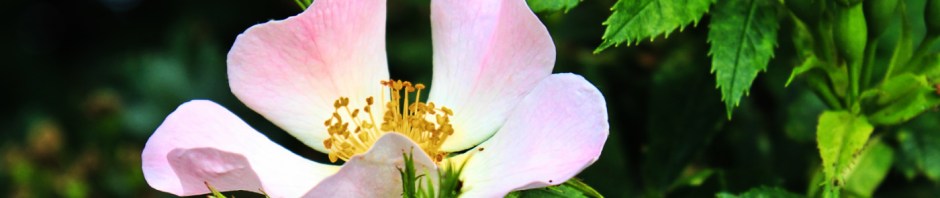
June. And the English hedgerows are threaded with roses. I brought home over a hundred photos of the wild and delicate blushing dog-roses. Which one to show you? A difficult decision.

English dog rose: Photo 7th June 2018
I chose this one. And this one . . .
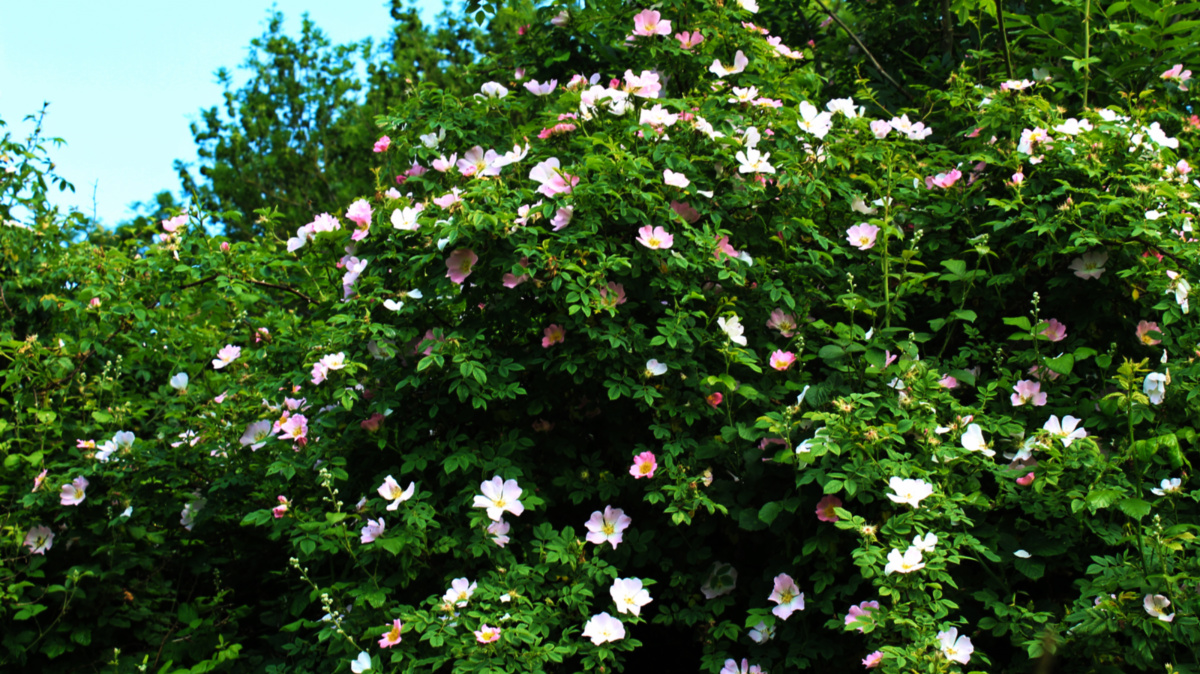
A hedge of roses . . . Photo 7th June 2018

 crispina kemp
Wild roses are a treat to find. Australia has no native roses, so those encountered in walks will be garden escapees or remnants of former settlers who’ve since moved to the big smoke.
The Yorkshire Dales have a variety of moss rose. Interestingly, the Moss family have the same motto as the Duke of Richmond: “en la rose, je fleurie” = “I flourish in the Rose”, a reference I think to Alan Rufus, whose epitaph twice describes him florally: “the flower of the kings of Britain” and “the flower of the satraps”. (Satrap = Governor in Parsi, Alan = Iran in the Alan language).
LikeLiked by 1 person
I had to look up the Moss Rose, cos I wasn’t quite sure of its origins. I thought it a damask rose and was half right. It’s a damask-Provence hybrid, developed in the late C16th by Dutch growers.
I know the eulogy composed by the monks (or at least the abbot) of St Edmundsbury Abbey (Bury St Edmunds) refers to Alan in such rosy terms but I’d put that down to the language of the day, e.g. the flower of knighthood.
LikeLiked by 1 person
The eulogy has that ring to it, but remember that his name in Breton is Alan ar-Rouz.
LikeLiked by 1 person
This is unusually taken to mean ‘red’, I’m not sure what Medieval Welsh word (as close to Breton as makes no difference) was for rose, but today it is rhosyn (with or without the ‘h’
LikeLiked by 1 person
Hypothesis: Since Alan lived in a Gallo speaking environment (Eastern Brittany, Normandy, Maine, the Conqueror’s Royal court, his Breton name, which indeed means “red”, would sound to those around him as “rose”.
LikeLiked by 1 person
Plausible though impossible to prove.
LikeLiked by 1 person
Wikipedia claims that the word “chivalry” was coined in the 11th century, which would make it about the same age as Alan.
Incidentally, I wish there were some way to know what he called his horse: it is prominent in several scenes of the Bayeux Tapestry, so I presume he was known to be fond of it.
LikeLiked by 1 person
The Bretons were Horse Lords; was them Tolkien styled the Roherim on.
LikeLiked by 1 person
Rohirrim, but yes. Duc de Rohan and all that. Curious that Tolkien chose Anglo-Saxon to translate their language. Mind you, the Breton Sovereign House were fair-haired, like the northern peoples, and it’s possible this derives from ancient Europeans like my blond Irish ancestors the Daírine who are very distantly related to the Norse (ten thousand years ago related). Hey, that’s early Third Age by Tolkien’s calendar, so why not?
LikeLiked by 1 person
If you look at the names he assigned his characters you’ll realise he also included (East Germanic) Goths and possible Slavics as well.
LikeLiked by 1 person
Tolkien adored the Goths and lamented their passing out of history: the charge of the Rohirrim at Pelennor is his tribute to their sterling work in the battle against Attila on the Catalaunian Plain in 451.
The Armorican Britons were there too, as archers: they were devastating against the Huns both in day (defending the Alan cavalry as best they could) and also when Attila attempted a night attack on the Roman camp: “the arrows fell like rain” and Attila decided then that he wanted a funeral pyre.
LikeLike
I take it you have read his ‘Legend of Sigurd and Gudrun’.
LikeLiked by 1 person
I have no problem with you posting more than one picture of roses!
LikeLiked by 1 person
Yea, but not a hundred! And every one is a beautiful picture. No naffs at all. Unusual, that.
LikeLiked by 1 person