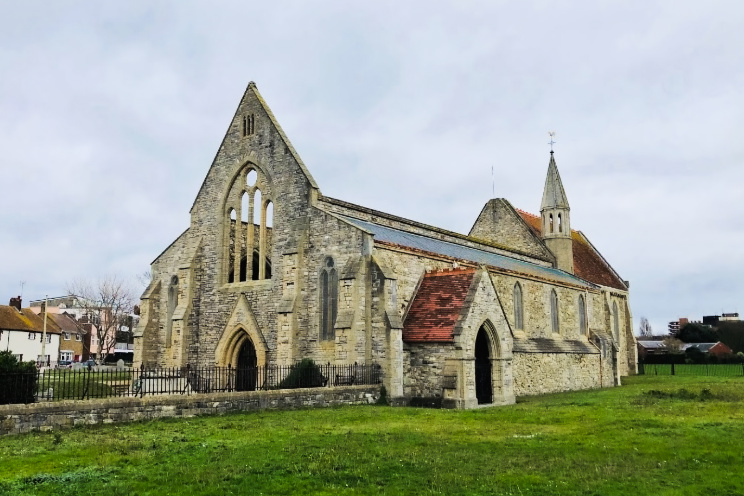
Portsmouth by Zee Tseng on Google Maps
You say Jean de Gisors founded Portsmouth? On land that he bought off Adam de Port? But that can’t be true.
In 1172 Henry Plantagenet exiled Adam de Port for his involvement in the Scottish Lion-king’s invasion of *the Borders*; confiscated Adam’s lands, including Buckland in Hampshire where Portsmouth was soon to appear.
How then could the wily trader Jean de Gisors have bought it from him? He didn’t, he bought it from the king.
Jean de Gisors saw the advantage of an English port, a place of his own. Wood and wine from his homeland, from England, wool and grain. No doubt he turned a tidy packet. But not for long. He joined the wrong forces in a Norman rebellion.
By then, Richard Lionheart rode the throne. Lionheart confiscated de Gisors’ land, including Portsmouth. It was the Lionheart developed the port facility of PORTSMOUTH.
Wordcount 145
Written for What Pegman Saw: Portsmouth, Hampshire, UK
Inspired, you might say, by what I found when I sought the origins. Yes, de Gisors did found the town. But he did little more. And he didn’t buy the land off Adam nor any other de Port.
There was no such thing as freehold property back in that day. The king owned it, and granted it out on various terms. And kings were notorious for snatching it back, e.g. between the death of the lord and installation of his heir. The additional income helped swell their coffers. Land was confiscated immediately upon any misdemeanor, even if later it was reinstated. So there is no doubt that when Adam de Port was exiled in 1172, never to be heard of again, the *Crown* reclaimed the estate. And the same is true when Jean de Gisors got caught in a rebellion.
BTW, tucked away behind Portsmouth is the much older port of Cosham, featured on the Bayeux Tapestry, it being in the hold of King Harold, as was Buckland prior to 1066.

 crispina kemp
Great research! And great story! 👌👍👏
LikeLiked by 2 people
I thank you. This is my … er, third love (after writing and photography)
LikeLiked by 1 person
What is your favourite research topic? I love to browse mediaeval history too. 😃
LikeLiked by 1 person
Without a doubt, local history, particularly of the Saxon and Norman eras. You might like to read the series of posts I did in 2017, beginning with *Written in the Soil* https://crimsonprose.wordpress.com/2017/08/26/written-in-soil/
*Enter the Scribes*; *Wufgyth of Karletuna*; *Edwin of Meltuna*; and *Family Connection*, completed the research which the later posts focused on three Anglo-Saxon will.
LikeLiked by 1 person
Wow… Looks really interesting! I love hearing about local history and culture around the world. Just shows how magical our earth can be… 😃
LikeLiked by 1 person
Time was when regions and countries were far more varied than it is now. Now … globalisation makes everything the same.
LikeLiked by 1 person
I really miss those good old days… Sometimes I really wish to step back in time and explore all the uniqueness each culture had to offer…
LikeLike
I used to long for what I saw as simpler days, lived more at peace with nature. Until I delved a little deeper. Except maybe in a few exceptional cultures those weren’t good days.
LikeLiked by 1 person
Yes, those good old days were also the times of cruelest tortures and gruesome deaths. Maybe light and dark are always bound together. 🙂
LikeLike
Not to mention prejudices, and people deemed sub-human cos of skin colour
LikeLiked by 1 person
Absolutely correct!
LikeLiked by 1 person
Absolutely correct! I am very much against these prejudices… birth don’t define everything, do they?
LikeLiked by 1 person
But that’s not how they viewed in those good old days. Also not how it’se viewed in various places around the world. But, I’m not a political creature, and I’m not going there on my blog
LikeLike
There are many people I personally know still judging over skin colour. I agree with you, no politics here.
Thanks for giving me such an amazing discussion!
LikeLiked by 1 person
Sometimes it happens … 🙂
LikeLike
Loving these snippets of English history.
LikeLiked by 1 person
I thank you. I enjoy searching them out.
LikeLiked by 1 person
An interesting bit of history. Back then it paid royally to stay on good terms with the king, but it was a difficult thing to do. 🙂
LikeLiked by 2 people
Very difficult when the king needed to raise money and you sat on an estate worth a steady income!
LikeLiked by 1 person
Another brilliant historical revelation….
LikeLiked by 1 person
I thank you, Violet. Any excuse to delve into history with me 🙂
LikeLike
I’ve just finished reading Kishlansky’s “A Monarchy Transformed,” in which royal “acts of resumption” were used to similar effect. Naturally, the people whose property was being “resumed” by the king were not happy. Safer taking it from rebels and minors.
LikeLiked by 1 person
Minors were the prey par excellence, I’d say. Having fleeced their estate you could then marry them off to the highest bidder, and rake it in again
LikeLiked by 1 person
And given life expectancies, there were always enough minors to around.
LikeLiked by 1 person
The heirs are definitely best. There’s a wonderful document, can’t remember the date of it, but it probably dates to the reign of King John, which lists all the heirs (male and female by county and worth. It’s like an auctionaire’s catalogue.
LikeLiked by 1 person
Another fabulous history lesson wrapped up in a short story.
You do excel at these Crispina.
LikeLiked by 2 people
It’s what I love doing. 🙂
LikeLiked by 1 person
Don’t I know it!
LikeLiked by 1 person
Love the historical tales!
LikeLiked by 1 person
I thank you. When I quit the history blog, I though that an end to my history posts. But I still sneak it in where I can 🙂
LikeLiked by 1 person
Interesting bit of history! I’m always amused by stories that have gotten twisted over time to seem to favor someone they shouldn’t – usually the person responsible for that version of the tale, naturally. I saw that roofless church when I was “touring” the area on Google maps and it’s really quite striking. Didn’t have any time to figure out why it’s roofless though; maybe later.
LikeLiked by 2 people
I didn’t delve into the identlty of the building; it was just the right period. It could have been the leper hostel, though it looks too grand for that; or a priory. They proliferated in the Norman and Plantagenet periods. Everyone trying to buy salvation for their souls, and washing clean their awful sins. Thou shalt not kill. And they did it in spades
LikeLiked by 1 person
when I was reading up for my entry this week, I did read a little about the King changing his mind – and how property changed hands – and your pots here brought it a lot more to life – thanks – and such an interesting tidbit about Port of Cosham,
LikeLiked by 1 person
Glad you enjoyed the read, and found it informative.
LikeLiked by 1 person
🙂
LikeLike
A great peek into history, Thank you!
LikeLiked by 1 person
Enjoyed the prompt, enjoyed the write, and loved looking into the history.
LikeLike
Fascinating history for sure. I especially enjoyed the rhythm of this piece. Sorry it took me so long to make it here! I’ve been traveling.
LikeLiked by 1 person
I enjoyed the delving. It took me back to me other love, the one put aside to focus on writing.
LikeLiked by 1 person
Awesome history lesson, Crimsonprose. That land of those buck’s, next to Peter’s field. And the Garrison’s Church lost its roof in World War II is where I went for school services whenI were a wee lad schooling in Old Portsmouth.
LikeLiked by 1 person
Wow, I chose the right church then? I was pushing close to the wordcount so I didn’t include that the name Buckland means Bookland, which was the closest you could get to freehold back in the day … back before Willie the Bastard took it all and called it his. The *book* was the charter that declared it yours, for ever and a day.
LikeLiked by 1 person
You did. You did. Haha Bookland. A place I would visit for sure. My muse has wandered off as I wander around Great Yarmouth 😳
LikeLiked by 1 person
Shame I’m busy, else I’d meet you in the Troll Cart for a drink. 🙂
LikeLiked by 1 person