A Confusion of Daughters

MC4_Confusion_of_DaughtersBeckoned over a bridge high over a chasm by a mysterious old man, and led to a cave, now Mideer has imbibed a foul-tasting brew. Is it prejudice only that says that doesn’t bode well? . . . Read on.

Perhaps I passed out though I’d say not (I’d no recollection of it). Rather, I saw lights—on the dark wall of the cave—the colours of fire, and ten times as bright. Not huge lights, not first. They began tiny, like seeds, then erupted and exploded before me. I would have been frightened but that they were restrained by some kind of sinuous net. But I was greatly confused. That, and the foulness in my belly . . . oh, and now a horrendous roar and a buzz in my ears!

I’m not sure when I realised I was no more in the old man’s cave. I was, instead, in an entirely and unlikely world. Perhaps now I was dreaming.

“No dream,” Hean said though I couldn’t see him. “This is the Holy Land. Feast. Feast all your senses.”

Feast all my senses, as if I needed his bidding—as if I’d a choice. Write it all down, they have told me. Yet how? So much I haven’t the words for. But as much as I can I shall try.

First, I now was outside on a plain. But it wasn’t the plain I’d seen outside the cave. That plain had been scantily scattered with trees and bushes while here was of a more luxuriant growth. Was I now in the jungle? I thought I ought to be afraid, and yet I was not. I was bewildered, I’ll not deny that, but I wasn’t afraid. And that in itself was rather alarming. Maybe it was because, though I couldn’t see him, I knew Hean was somewhere here with me.

The sky—let me describe that. It was night, there were stars. Yet they weren’t the twinkling white we see in our night. They each were a tiny kaleidoscope rapidly spinning with sparkling colours. And the colours fell from them, like rain, and I tried to catch them. I wasn’t alone in that. A beast of sorts was rearing up, maw full open, guzzling of the falling spangles. I watched falling spangles and guzzling beast for an uncountable time—perhaps for a year, perhaps less, perhaps less than a minute. Time seemed to yawn and contract as if it were breathing.

There were flowers. Yes, I suppose you could call them that: flowers. Yet flowers are plants and these weren’t that. They were . . . I suppose you could say people. People whose flesh was growing these flowers. Such a strange thing, I laughed to see it, and that seem incongruous. Yet these people didn’t remain people for long; now they were birds—brightly petalled birds that filled the air with their song. Strange, that their song had human words. Oh, it all seems so very confusing now I try to tell it. Yet it all seemed right at the time, as if this was how the world ought to be.

And there was a snake.

No small snake this, and neither evil. She seemed . . . I suppose you might say friendly. She oozed acceptance of me. Love, yes, that’s what it was: she oozed love of me. I held out my arms to her, inviting her into my being. And she came.

How she entered I do not know yet she was within me. I was aware of her there, aware of her cleansing me (from the inside out—yes, that’s how it was). She moved with sinuous motions through the base of me, through my organs, through my intestines and into my heart. She wriggled herself through my airways. She wreathed and climbed the tree of my spine and entered my brain. I remember how I smiled at that. I chuckled. I grinned. I was happy, so happy, content to have her coiled there.

“Who are you?” I finally asked her. “Our Mother?” I meant our Mother-Goddess.

Though she offered no words yet I knew her answer: « I am the Daughter. »

“The Mother’s daughter?”

Again, her wordless answer, « No. » She showed me.

Between the people who really were birds, beneath the trees that were star-sated beasts, all around that plain before me, there sprang what I thought at first were a hundred-million fungi. Earth-balls, perhaps. But even as I watched so they grew taller, and more turgid. There was a great tension, I could feel it inside me, almost unbearable, as their filmy skins stretched over their straining glans. Then, all as one, their hundred-million skins ripped and tore, and they showered the land not with spores but with a thickly viscous pearlescent fluid. Me, an unbroken virgin, ought not to have known what it was, yet I did.

“You are the Daughter of the land.” I said. “This land, I mean, this Holy Land?” I knew the Holy Land wasn’t the land of Macara.

Apparently I had said it right for then she left me. Yet it was only to twine into a tree. She left her voice within me. « See, Holy Daughter, me. »

The tree blossomed. Yet . . . the blossoms weren’t flowers but coupling snakes—coupling as they do in spring. Thousands, beyond any counting, hanging from every branch and small twig, from the top of the tree down to its very first sprig. And as they ripened they didn’t fall as blossoms will do but they drifted away, bubble-like floating high into the sky there to form a hundred waterfalls, cascading down. I knew, though she didn’t tell me, that this she was showing me was the line of the Queens. It reminded me so of the tree in the painting in my mother’s own chamber, the tree that was to be mine.

Branches fell from the tree. Some landed and withered and faded away. Others rolled log-like until hitting a stone they upended and rooted and grew and blossomed. I wanted to say, for I knew it, that these were the lesser daughters in every generation (for only the first three born were eligible queens). My eyes searched the tree. Where was the line which would be mine?

But before I could find it my eyes were distracted. From the newly-rooted branches fell a myriad of multicoloured petals. And as they fell they changed to seeds. But not, as you’d think them, hard encased things. No, squirming these, as wormlike they buried into the ground—thence to erupt as more fungal-heads.

« You know what it means? » she asked me.

And, yes, I knew its meaning. I believe I always had known though it always had been buried deep, awaiting this moment to erupt like those heads. “Every Madja-woman is related to me. We all are descended from the First Queen.”

« Every woman of the Three Lands, » she corrected me. « Of Macara, which is the Mother; of Madjaria, which is the Middle; of Glyntland, which once was the Father. »

I must have pondered on this yet it seemed that I didn’t. for my response was fast-coming. “Then the prophecy doesn’t belong to only me?”

She laughed. And with her laughing I found myself smiling. Yet—

“The Macaran . . . ?” I frowned. “No, they cannot be Queen. And the Glyntlanders? No!” And at once I felt abashed of what I had said.

In an instant, before me appeared an infinite range of numbers, all busily changing, all confusing. I knew their meaning: they were Glyntlanders. I didn’t like them; I wanted them gone.

She untwined her body from the tree and spread her mass across the numbers and bit-by-bit and little-by-little her massive body simply absorbed them. « My children, » she said (though afterwards I thought I’d mistaken and she had said, « My husbands, my men. »).

“But . . . ! No!. Glyntlanders care only for numbers, for coins.”

« And in the beginning there was the Queen and her three daughters, » she said which ought to begin an ancient tale I’d known from the nursery yet didn’t. « And becoming women each of the daughters went a separate way. Three different ways. Macara. Madjaria. Glyntland. Which way is the right way? You would judge them? »

I sat back, feeling shame and deep in guilt. I was sure I stank like I’d rolled with the swine. Bile filled my mouth. I shuddered. I wanted the stink and the taste and the shame gone; they were spoiling my pleasant day. I knew the way to be rid but I didn’t want to say it. I didn’t want to admit that the Holy Daughter was right. Who was I, by what knowledge, by what right, did I made this judgement against the Macara and the Glyntlanders?

« Mideer, » the way she whispered my name was like warmth caressing me, loving, accepting. Yet it made me feel the shame the worse. « Mideer, there is no ‘right’. No ‘wrong’. No ‘good’. No ‘better’. No ‘best’. There are only a myriad of different ways. Each has value. Each belongs. Accept. »

*

As I’d had no awareness of entering that land so I had none of leaving it. I merely found myself by the old man’s hearth in the cave with a belly that wanted to eject whatever potion I’d drunk. I felt gross. I was sweating. Parts of my body were tingly, other parts seemed not to be mine. I want to sleep and yet to escape—but escape what? My body? My guilt? My shame?

It took me a while—registering my ailments, wallowing in these foul sensations—before I noticed the old man was gone. In his place was Hean.

He nodded to me. I wasn’t sure what that meant except it felt good. I was pleased for a reason to smile.

“I shan’t ask you,” he said. “I’ve been there.”

“You met the Daughter?”

He nodded a gentle assent. He seemed to be smiling though not with his mouth. Perhaps it was coming from deep within him.

“Now,” he said, “and what will you do to complete the prophecy?”

“Can’t this wait till I’m . . .” But I suppose he wouldn’t have asked so soon if it could wait. “Return to Madjaria. Tell them what I have seen.”

“And what have you seen? I mean, what have you seen that will convince your Madja—priests, lords and all—that they’re wasting their energies in resenting the Glyntlanders; that those Glyntlanders aren’t so bad? I suppose that is your first call. Then I suppose you’ll do likewise for the Macaran? Well?” He looked at me.

But what amongst all I’d seen could I tell my Madja that would convince them?

“And, of course, your people, the Madja, will listen to you, breath-held in awe,” he said, stacking high the obvious objections that had escaped me. “The charismatic new queen, teaching her people the basics of love. Is that how it’s to happen?”

I now felt awkward, looking about me, not at all liking what Hean was saying, yet recognising the truth of it.

“Anyway,” I tried to duck out of it, “who’s to say your prophecy refers to me. Every woman in all three lands—EVERY woman—we all are descended from the same Queens Line. Your prophecy could refer to . . . to any one of them.”

He chortled softly, the while shaking his head. “Yes, you speak true: Every woman is of the same Queen’s Line. But not every woman has been raised in the Queens House; none trained to the role that now awaits you. You think the Madja would accept any other but you?”

“My uncles’ daughters. They’ve been raised there too.”

“Your uncles’ daughters.” He nodded and chuckled. “Oh, indeed, your uncles would like that. But first they must battle, brother to brother and wed-man to wed-man, until they agree whose daughter to name. But, Mideer, those girls, those women, have not been trained to it from birth as have you.”

I sat up sharply—which was a mistake. I hadn’t realised how much my head hurt. Had the cave spat rocks while I was away? Yet the worst of the pain was inside, within the brain-case. Lords! But I didn’t ever want to drink that muck again, no matter that it did transport me to a Holy Land.

“I have not been trained from birth,” I objected, slowly and not too loudly, yet firmly. “I received no training until . . .” I paused while I thought when it was. It must have been when the Landed of the Assembly had grown weary of waiting for my mother to produce the next king. No sons. Just a single child. Me.

“Mideer, think,” Hean pressed gently (I guess this was the first time I really suspected he might know my thoughts). “Your father has no sons. None.”

That was true. 329 daughters (as far as known), but not one solitary son. I’m not the eldest of his children. Half of those daughters were born before me. Heading-on 200 children before I was born and not one son amongst them. By the time of my birth, I’d wager, the Landed of the Assembly had long been talking.

“You have been trained to this from the day of your birth,” Hean persisted.

“Then why no talks of succession until—”

“Your mother, Queen Megan, is dying. It had to be done, to be set in stone. You cannot imagine the chaos caused by a vacant throne.”

“Hean, sorry, ” I said. “I need fresh air.” I held out my hand for him to help me.

*

Outside the cave I still wasn’t able to stand unaided. I rested against the rock-wall and allowed the air to wash around me, to fill me, refresh me. It felt . . . it felt like I was newborn and these were my first breaths.

“Now,” Hean said, “shall we try again? How do you intend to complete the prophecy?”

“Good, better, best,” I said, and he seemed to understand my intent.

But though he nodded still he objected. “And you are an untried woman. Though their future queen, you are no priest, no preacher. Why then should they listen to you?”

“I could . . .” But I didn’t know what I could do. I was wildly searching for a solution (not easy with a head that hurts this much). Then what seemed to me a solution: “I will instruct my father in it. They’ll listen to him.”

Hean raised a brow at me. I looked away. “If I had told you these things you now have learned—”

“Of the snake-tree?” I asked. “Of we women all being one line?”

“Is that all you have learned?” He raised that same brow at me.

I looked away, speaking now to the plain instead of to him. “I have learned, too, of the good, the better, the best: that we all have the same values, we just tread different ways. But I’ve already said of that.”

“So consider this: If before we came here I had told you these things—and we ought to be walking,” he said, a glance off towards the darkening sky. He held out his hand, to beckon, to encourage, to lead me away. Where would he take me? I don’t remember ever asking it. Did that mean I now trusted him implicitly? He said, now we were walking, “If I had told you these things when we were still in Madjaria, would you have understood them?”

I was quiet while thinking on that, and he didn’t press me. And now I could see our destination: a village in the distance, quite close to the shore.

“I would have believed of the tree—it’s there on my mother’s wall.” It had not yet occurred to me to ask how Queens House had came by their heirloom. “But I admit I would not have understood of the other. Can you imagine the priests saying to me of the ‘good, better, best’? No, it is the antithesis of what they teach. They want to keep us all hating each other—baiting their gods, for a baited god grows strong.”

As soon as I said it I shuddered. For I realised with a sickening sensation that this was exactly true. And it is true, you priests. Moreover, you keep us hating the Macaran and Glyntlanders so we don’t stray towards them, begin to like them, to understand them. You keep us tied to your strings where you can control us. And, for saying less, men have lost their heads, so don’t say it’s not true.

“Hmm. Good,” Hean said. “Now, Mideer, see how your wrappings are falling away? But the same isn’t true of your people. And it certainly isn’t true of the Glyntlanders.”

“I know where you’re steering me,” I said. “I know what I must do. I must show them.” We were almost at the village before I added, “But how?”


Mideer has learned many things from her visit to the Holy Land. Some things cannot be put into words. Others are hard to put into action. Yet there was one lesson that threads through them all: that to ‘see’ is to understand. Now, if she can find a way to apply it she might thereby—maybe, possibly, perhaps—fulfill the prophecy. But she’s not there yet. And then there are the priests to contend with . . . and her uncles, maternal and paternal. See the next episode, A Spot Too Tight.

Posted in Fantasy Fiction | Tagged | 12 Comments

Blindly Into A Cave

CM3_Blindly_Into_A_CaveHean has brought Mideer to the island of Macara. Something to do with ‘unwrapping’, to fit her for the prophecy she is to fulfill to unite the three lands, but more he won’t tell her. But after the headman’s incomprehensible babble to which, apparently, she had failed to respond, she now is surrounded by Macaran spearmen, her own corps seemingly numbed into inaction. And where is Hean? There is no  sign of him . . .  Read on.

Ignorance, I object, is not bliss. Rather it is terror and a frantic search for explanation—any explanation. But none was forthcoming. Meanwhile  these spearmen proceeded to ‘escort’ me I knew not where, nor yet for what reason. I’d said in jest of providing their meal but now I wasn’t so certain. And, again, where was Hean? And why did my supposedly protective corps do nothing? Why didn’t they rescue me?

I wanted to rail and bewail. But to what effect? That’s hardly the desired image for the future queen of Madjaria. So instead I offered some panicked beseechings to every one of our gods. Yet even as I rattled the words I doubted any would hear me so far from our home. Our gods—your gods, my priests—do not travel so well, being thoroughly attached to the land.

Questions raked through me. Did these Macaran intend to kill me? Would they eat me: I mean seriously eat me? Then I remembered their reputation for raping women. At that my body launched into a sweat. Oh gods of odd hue, where was Hean? Why was he allowing this to happen?

It was then this thing of my uncles, maternal and paternal, hit like a hammer. I realised until then I’d been toying with it: putting it on to see how it feels; pulling it around to see how it responds. Now I suddenly saw it in all its frightening clarity. What more perfect way to be rid of the heir apparent. For without me, Queen Megan’s daughter, they would have no recourse but to name the eldest daughter of my eldest maternal uncle who then would wed Jon, my baby cousin. Even if these Macaran didn’t kill me, all they need do is to keep me here and never release me.

But was Hean a part of this? Could I believe that? Was he in the pay of my uncles, all this talk of ‘unwrapping’ a shabby deceit? And I had fallen for it. Now, even more than ever, I was that game-piece, heedlessly manipulated.

*

My captors did not mistreat me. That gave me hope that they wouldn’t kill me. If only I could understand their speech—just a little of it. Why hadn’t Hean taught me at least the basics? Yet to what effect? Did I think I could talk myself out of this? No, but perhaps I’d pick up from their talk some clue as to what was happening. Only they said not a word. We walked in silence.

Ahead I could see the land beginning to rise. It wasn’t long before we were climbing. So were they taking me to their village? I supposed they did live in villages, even if on a temporary basis. I mean, they must live somewhere.

Though the climb began slow it soon became steep. The track now was strewn with sharp stones. Despite I wore shoes, I could feel them jabbing my feet; feel the stones and the heat that rose from the ground. How did their feet not burn? For none wore shoes. On, and on, higher and higher. Would they imprison me in a high cave, there to freeze to my death? Yet rather that than to descend to the valleys with their dangerous beasts. And who had told me of this? Oh, none other than Hean, of course. He had now thoroughly slipped from my trust.

Midday: I knew the time for the sun beat directly upon us burning my unprotected head. We crested the narrow pass—at least, that’s what I thought it to be until we were there. Then . . . nothing. No further track leading up. None leading down. Nothing! Just an abrupt declivity. To my horror, we stood at the very edge of a deep abyss. A rock-formed chasm, at the bottom of which (if I dared to look) was a river raging white—though I only knew that by its roar and the steam that patchily veiled the jungle-jammed valley below. So (gulp) . . . whither now?

The answer seemed to be a rope-formed bridge that crossed that chasm.

To say I didn’t want to go there is an understatement worthy of any Glyntlander. The bridge comprised but two ropes: one for the feet, the other for the hands. Moreover, that rope looked terrifyingly fragile to me. I turned, refusing—and there stood Hean! I almost cried at seeing him. All mistrust forgotten. Blessed, blessed Hean, whence he? But far from coming to my rescue, he signed for me to turn about and face the chasm with its terrifying bridge.

*

There stood a man upon that bridge. Though I swear he’d not stood before. He looked . . . ancient: as if carved from some gnarled part-rotted tree with sun-bleached vines and mosses for hair. He held out his hands to us—No, to me. For now I realised I was alone on that precipice. My armed escort had mysteriously melted into the rock. (Though more likely they’d retreated when I wasn’t looking.) Hean remained. He nodded to me, encouragement—Yes, accept. I might have been more eager had he made some sign of accompanying me.

I did not want to cross that bridge. I did not want to go alone with this most ancient man. Who was he? But there he stood on the bridge, beckoning me. And I found that I dared not refuse him. Was that Hean’s doing, pushing me on? For all my previous doubts and mistrust of him I guessed this crossing could be part of his training of me; that in some way it would aid my ‘unwrapping’ as he had called it. (Though I was also aware I could be clutching at explanations.) I remember wondering, was this part of a Macaran rite.

Despite since our arrival in Macara Hean’s behaviour hadn’t exactly inspired my trust yet, I argued, I had agreed to his training of me, and that training required that I trust him. And I could certainly see how this crossing could be a test of that trust. All those things I’d been thinking of him, in cahoots with my uncles, maternal and paternal . . . was I to allow them to fall away?

Oh, but I did not want to cross. If I could have flown like a bird I’d have done it. But to set foot on that rope, above that abyss, with the river roaring, and every savage beast down there. Hah, but if I fell I’d be dead before they came prowling around me.

As soon as I set foot to the bridge it violently swayed, the two strands separating. I took a deep breath, hoping the meagre structure soon would steady. I chanted a charm I’d learned in my childhood. I called upon whatever gods present though they’d not be my own. But, NO! Hean had said these Macaran were godless. No gods, then. No gods to call on.

I took another deep breath. Somehow, despite the incipient panic, I had managed to reunite the two strands of the bridge. I figured then to do this quickly. Don’t look down. Don’t think what I’m doing. Just get across there quickly. Soonest done . . .

*

The old man was gone. That’s what I thought now I was across the bridge. I looked around but couldn’t see him. All I could see was a track leading down—down to that ghastly dread-filled valley.

What to do? I looked at the bridge. But I wanted never to set foot upon that two-stranded structure again. Maybe if I waited Hean would join me? At least I was pretty sure now this ‘adventure’ was all part of his training of me. I mean, he could have been rid of me without bringing me here to this bridge. He could have just pushed me over the edge.

So I waited. And I waited. And I waited.

No Hean.

Instead the old man returned. From his gestures I gathered he’d been waiting for me a way down the track. He beckoned me on. Well at least this track was easily walked . . . though, how far would he take me? I refused the thought that he intended to make a sacrifice of me, to feed me to flesh-eating fish. Indeed, I convinced myself to be . . . confident. Yes. And trusting. After all, nothing bad had happened. Yet. But there still was the question of where he would take me. And once there . . . ?

To answer my first question: he wasn’t taking me into the valley to feed me to fish nor beast. There appeared a cleft in the cliff and, though a tight squeeze, this led onto a plain. I smiled—perhaps the relief to be away from that chasm and the jungle beneath it. But more likely because here was pleasant. Here was a balmy breeze perfumed sweet from the scattering of trees. Though I was surprised to see no village here. No buildings at all, no matter how basic. There was a herd of . . . something. Perhaps they were deer. They weren’t sheep or cows, that I do know. But then, to my surprise, he didn’t lead me across the grasses but held close to the rock-formed cliff, here as steep as it was beyond.

I didn’t see the cave until we were upon it. In truth, I didn’t see it until my guide disappeared and I had to look for him. Where could he have gone? Answer: that dark-shadowed hole had swallowed him. Whither my guide, there goest me. Rather that than to stay on this plain. Alone. Though Hean had said nothing of any nasty beasts here. But, then, he didn’t need to.

You remember Samlin, priest to my father when I was a child? Well, I remember him telling me about the Landed-lords’ hunting birds, their birds of prey. He said, where there is a vulnerable creature, there too will be a predator. But the predator is not to blame and must not be reviled, for the predator needs food as much as the prey.

Now here on this otherwise most pleasant plain were vulnerable deer. And though they had the protection of being a herd, they hadn’t the protection of a human herder—at least none that I could see near. Therefore, somewhere on this plain there would be at least one predator. And I had not a herd around me.

Like or not, I followed the old man into the cave.

*

He hadn’t had time to build a fire and to light it. Yet there he sat cross-legged upon the floor, a fire merrily burning before him. He indicated that I should sit. I sat.

I am not used to sitting on hard rock floors. I soon felt the discomfort. Yet looking about I could see nothing that might soften my ‘seat’. That’s where a cloak and my old woollen gown would have served. I jiffled, trying for a more comfy position. The old man looked at me. Despite he said nothing, and I could see no facial expression to tell me, yet I knew I had to sit still, which I did. After one last squiggle.

The old man had been wearing only a loin-cloth. And I had followed behind him all the way here. And though I’d remained at a distance I swear had he been carrying the paraphernalia that now sat beside him I would have seen it. Therefore, I reasoned, he had prepared this in advance. I allowed my thoughts to range over that. Perhaps it was always kept here . . . in readiness, on the off-chance? Or perhaps he had hurried ahead while Hean was jabbering away to the headman? Then again, maybe he had been pre-warned? Some arrangement, perhaps, between Hean and him? Though I couldn’t see how. Even if I wanted to believe in telepathy (and I had had cause to wonder at times with Hean) a two day-and-night journey lay between them. So no, this last I couldn’t accept as explanation.

Further mulling was denied me. The old man handed to me what appeared to be a heavy pot. In that I was right: it was heavy; heavy with liquid. And that liquid was thick. It had the consistency of a creamy sauce you might put on a pudding except it was more oily than creamy. And it didn’t smell sweet. It smelled . . . pungent, pungent and foul. Yet not foul as in spoilt. Not rotten. Not even fermenting. Just . . . unpleasant, as if it advertised how bitter. And it was bitter.

He signed to me that I should drink it. I lifted the pot, reluctant to sip. No problem there. I wasn’t to sip it, he signed. No, I was to take it straight down.

Maybe two-thirds slithered down my gullet. The rest was ejected by my throat’s outraged spasm. Memories of my recent seasickness didn’t help. I dearly wanted to upchuck the rest. Lords! What was it doing to my guts? Corroding them? Setting up a colony of fungi? Turning my guts and me inside out? By the Lords, but I wanted to heave, heave till my inwards were thoroughly outwards. I had a vaguely slippery notion that Hean’s ‘unwrapping’ was about to begin. Quite literally. And being unwrapped I then would be naked and raw.

There was no sympathy from the old man. He seemed to find it amusing. He signed that this . . . this . . . foulness wouldn’t last long. Oh good. But what would come next?


Foul potions tend to a limit range of effects. To kill. To render unconscious. To cause an upswelling of everything eaten—though Mideer has already vomited. To cause a disruption in veils of reality. Find out in the next episode (Tuesday 5th July 28), A Confusion of Daughters .

Posted in Fantasy Fiction | Tagged | 12 Comments

Godless

MC2_Godless_StormMideer is to go to the tropical island of Macara, home of the reputedly savage Macaran hunters—and how did her tutor Hean slip that past the king and Assembly? And why there: what is it about Macara that’s essential in this mysterious ‘unwrapping’ of her? And how would that help her to fulfill the prophecy? Read on . . .

Was it a boat or a ship? Of course, I hadn’t then seen the Glyntlander vessels. Yet ours was no cockle, fit only to sail round the bay. There were quarters for sleeping, for the captain, for me and for Hean. The crew and my corps slept on deck. The hold, I was told, was tight-packed with gifts.

“Gifts? Bu-but why? The Macaran have no king to need our gifting. Ah! It’s gifts for their gods. So what are we giving them?”

“No, they have no gods,” Hean said. The crew and my corps, overhearing, gasped. They were already scornful of this Outlander who spoke to their would-be queen without as much as a respectful nod and no ‘My lady this’, ‘My lady that.’

“Godless?” I voiced their fears. “So the talk is true: they do worship demons and devils? I’m surprised my father allows me there.”

“Mideer, your fears are due only to the conditioning of your past lives—so many of those lives. This is the reason your packaging all must go. This is my task, and this I have told you.”

“Then are you saying these Macaran are not godless? Yet just now you said . . .”

He rolled his eyes. “I will not discuss it. I have already stated my refusal, I will not say overmuch of what’s to happen. I want from you honesty, not something pre-formed.”

“So . . .” I shrugged back my shoulders not to be seen by the crew or my corps as chided, “if not for their gods, for whom the gifts?”

“We have brought for the Macaran the gift of fruits.”

“Fruit? They have asked for it? Ah, fool me. So far south, they’ve suffered a drought, and now we must feed them—for which, of course, their gods will be grateful. And being grateful they’ll welcome us and not cause us storms to wash us away.”

Hean again rolled his eyes. But at least now we were leaving the port we’d no audience the crew busy with their crew-duties. I noticed at least half of my corps looked wistfully back to shore. Were they as anxious as me? I guess the crewmen weren’t but . . . I wondered how many had left a young family at home and feared never to see them again. But Hean and I were still talking of gifts.

“No one is starving; we need not feed them.” Hean said. “Neither have they asked for what we carry. It is done from politeness. As the Landed bring gifts when they visit your father, King Gehon.”

I squinted at him, and not only because the sun was against me. Truly, I did not understand. “The Landed bring wine to ply the king hoping to inebriate him, that in his drunken stupor he’ll agree to whatever their wants. Is this the reason we’re to give the Macaran a whole hold of fruit? To oil our deals? Then I must ask, what deals? Have we become Glyntlanders?”

Hean sat me down—for which I admit I was grateful. The ship—boat—whatever you’d call it—had hit open water. O Blessed Sea Mother!—and we weren’t yet into the treacherous parts. I thought it likely I’d spend the journey prone in my quarters.

“We bring them a gift to honour them,” said Hean.

“Honour the Macaran? But . . . I mean, they’re only Macaran. Ah!” Realisation grabbed me. “It’s so they don’t kill us as soon as we step onto their land. So they’ll know we’re not those grabbing Glyntlanders.”

As you know, the Glyntlanders long have dealt with the Macaran. But while they called it ‘deal’ rather, now, would I call it rape, a rape of the land. But as yet I knew little of that, only that the Glyntlanders ‘acquired’ certain ‘commodities’ from Macara (i.e. the chemicals required for their manufacturies). I was yet to become fully informed upon the depth and reality of that.

In truth, I admit, my head was a muddle. I didn’t want to be leaving Madjaria. I feared my mother would die while I was away. And I didn’t trust what might happen behind my back. Moreover, I still didn’t know whether to trust Hean. What if he was in some conspiracy with my uncles, maternal and paternal; what if he had some magical hold over my father? And my thoughts might have been clearer had he taught me nothing at all. But now I was half-in and half-out of my people’s values, half-believing, half newly-seeing the truth about me. Also, I feared I might fail in the prophecy and in some gruesome way meet my death. I tell you, on that day of leaving my head was in a worse troubled state than my belly—and that didn’t feel good.

*

There was a storm. But you don’t need to know that. I thought I would die, so certain the ship would break beneath the hammering waves and would sink. I expected it at any moment. I clung to my bunk, feeling utterly wretched, with Hean wiping my brow. Oh bless the patient, tolerant man—though I’d have preferred to have my lady Loyse with me. The savagery of that sea seemed to last an eternity, so wretched did I feel. The rain raddled the roof-cum-deck above me. The wind screamed through the sails—like ghosts howling for revenge. We could not survive it; it seemed impossible. Yet I woke the next day with the ship gently rocking—and there was Hean, still holding my hand. He told me the storm had lasted less than a day.

“We’ll be there,” he said, “before this night. You might care to wash? To change your clothes? Something more suited?”

At his prompting I looked at myself. My gown—a deep crimson-red wool, heavy and warm—was befouled with the acidic slime of my guts. It stank. And it was wet. And in being wet it was heavier yet. And in being heavier it scarce held its shape. It was not a good advertisement of me, of Madjaria and our Royal House. I shooed Hean away. But what to wear?

“A shift will do fine,” he called through the boards of the door.

“It would not be decent!”

“Mideer, I have seen your shifts—”

“What?!”

“On the bushes to dry in the kitchen garden. You will be as decently clothed in a shift as you are in a gown and a wrap.”

I shrugged, for I supposed it was so. And who but these Macaran were to see me . . . and my corps . . . and the crewmen. And Hean. But I was not so ‘unwrapped’ as to be happy naked. However, rummaging into my trunk—a trunk I neither packed for myself nor supervised—I found I’d no choice but to wear a shift. While whoever had packed for me had included several of the simple white linen garments, they had included no other gowns. I was surprised to see the culprit had at least packed a spare cloak for me.

Oh, Loyse, Loyse, why did you not accompany me? But she did not, so pointless bewailing. And this past day or so I had managed without her. It’s not so hard to comb out one’s hair, to wash one’s hands and one’s feet. And that other matter was nigh a month away; I hoped to be home by then. Even so, I did wonder at my father, that he allowed me this voyage with no woman attendant. What had Hean said to him, that he so agreed it? I glanced across to the door, again feeling uneasy about Hean. Kind man though he seemed, exactly what interest had he in me? Was it only because of this prophecy? Or was he in league with my uncles, maternal, paternal or both?

*

Macara. Have you been there since my voyage? I know few had been there before but now we hear the sea-captains barking that ‘Queen Mideer has opened it up’, hoping to earn some extra coin on a journey.

It is a mountainous land; a land of valleys and heights. Snow lies late upon those heights despite in the valleys there are sweltering swamps. Ah, those swamps. “I prefer not to say much of Macara and its people,” Hean had said more than the once. Yet he told me of what lived in those swamps. Snakes. And leeches. And fish that will strip the flesh off your bones. And others that jolt you clean out of the water as if you’ve been struck by lightning. And then there are beasts. Unimaginable. Some equipped with teeth that will crunch through a bone as easy as look at you. Of all the things Hean kept to himself, why had he told me of the swamps?

It is perhaps because of the uninhabitable valleys and the forbidding cold of the peaks that despite Macara is thirty-times the size of Madjaria, only seven bands live there. Seven separate bands that each speak a different tongue. Seven only, and they not populous. Seven, when we have 150 Landed-lords with all their households in a land a thirtieth of its size.

Between the valleys and the heights are the plains—plateaus I should say: some quite extensive. It’s there that the Macaran live. Though I know you’ve now seen at least a few Macaran walking the lanes of Madjaria yet I will describe them for prosterity (at least, the bands that I saw) so none need fear them or misrepresent them again.

The first thing noticed is—well, two things really, simultaneously. The men are bald. At first I thought that a natural state but then I discovered they shave their heads. Those living in East Macara shave only the front. I think their different styles serve as a badge of sorts, like the devices painted upon our Landed-lords’ shields. More universal amongst them is their complexion. The Macaran are darker than any here though, it’s true, not all Madja are corn-field fair. Our farmers who labour each day in the sun, our fishermen inhabiting the Madjarian coast, are roasted dark as toffee. But beside the darkest the Macaran are darker.

It was on seeing their complexion that a strange thing struck me. Though in all the time Hean had been my tutor never once had I noticed it, yet beside the Macaran Hean now seemed equally dark. He could have easily been taken for a Macaran. Indeed, by his behaviour and everything around him too. But there I go jumping ahead again.

In all the time I stayed in Macara I never saw a native with hair as fair as one finds amongst us, not even amongst their young. I remark on that for though my hair is now burnished brown, yet as a child my head was golden-crowned. But one doesn’t find such colouring there.

Though I took in the whole of their appearance lightning-fast, to describe them needs some kind of order. So, their next striking feature is their bodies (and who can avoid noticing them when they wear so little). Everyone, old and young, looked as lithe and as firm as our best-bred horses. I saw no crocked backs, no humped shoulders, no flabby bellies; none of the postural defects found across our lord-lands after long years of farming. I saw no blackened teeth either, though I did see some missing. Hean tells me that’s part of a religious rite, same as the markings upon their bodies, pricked in with soot.

Also, everyone there seemed happy. Though that I discovered was only a first impression.

We were greeted . . . no, let me be accurate in that. Hean was greeted. He was greeted like a returning brother. The children danced around him. The women variously grinned and cried. The men patted him. At first I thought it for the sake of our fruit. Yet how could they know what we’d brought? Moreover, when we Madja disembarked they suddenly stood back a distance.

I ought here to explain that they have a harbour some little distance along a river, complete with wharfs and wood-built quays and . . . you know, as we have. That surprised me for they, like we, are not reputed sailors. Indeed, I’d say we’re more sailors than they. But then I remembered the Glyntlanders interest in this southernmost land. And now I’ve seen the Glyntlanders’ vessels—how huge—I can well understand how they’d need such proper facilities. Whereas we, on this visit, might have easily used a simple cockle to reach the shore.

As I said, the Macaran stood away as we disembarked. Did they fear us? Did they think us Glyntlanders? Yet the Glyntlanders are fairer even than we. Did they think we’d come to plunder? Perhaps. For it took Hean some rapid speech to persuade their headman to come and greet us—or ought I to say, to greet me.

It was an awkward moment despite Hean had tried to rehearse me. I was a visitor, I was a supplicant, he’d said. The Macaran cared not that I was the future queen of Madjaria. I must remember at all times, it was I who sought them. I who asked of them a favour. I did?

Then to confuse me Hean had changed how he said it. “Nay! You ask more than a favour. You ask for an honour.”

Fine talk for him, an Outlander, possibly (as now I could see) a Macaran. But for me to be anything other than a commanding queen-in-the-making was far outside my usual realm.

“Imagine the headman is your father,” he said. I suppose he thought he was being helpful. It would have been more helpful to tell me what the heck was happening. But I played along.

“You want me prostrate upon the ground?”

“When have you ever done that with your father?”

“When our audience is public—as this meeting will be.” He ought to have known that. “But, Hean, I cannot lay myself down on the ground. I just . . . cannot. Supplicant I might be but . . . no, please, leave me some dignity.”

My outrage seemed to amuse him in his typical Hean-ish way. I swear he has an innate sense of irreverence which amuses him mightily. He said, “There is no need to graze your knees upon the ground. Just hold in mind that you want something from him. And the only way to acquire it is to be humble. Grabbing it as if you’re a Glyntlander won’t work. Neither will demanding it as if you are a Madja-lord. Could you possibly adjust your manner to that?”

It was during these ‘rehearsals’ that it most forcibly struck me that I didn’t yet know what I was asking. Hean hadn’t said. He wanted me to know as little as possible so I could be honest in my reactions. All I knew was that this was part my ‘education’, as he put it, an acceleration of my ‘unwrapping’, the better to fit me to my supposed destiny, i.e. to fulfil the prophecy. But he had been appointed by the Landed of the Assembly, agreed by you priests and my father too, thus I must trust him. Yet he was also appointed by my uncles, maternal and paternal. That ought to have alerted me. I ought at least to have questioned.

*

I held a humble image in mind as I responded to the headman’s greeting. I had not a notion of what he was saying, and Hean didn’t think to translate. Perhaps I wasn’t supposed to know. He could have been asking me to dinner—with me as the main course. Toe, or a finger, for hors d’oeuvre? We have brains for desert—or would you rather minced tongue on biscuits?

The headman gabbled at me. I smiled and tried to be small. That wasn’t easy. The Macaran are not a tall people. Also, I tried not to look at his sleek muscled limbs. I was not used to this, this excessive ‘undress’. So much flesh. And all in such remarkable condition. I’d wager few Madja could stand beside a Macaran and seem his physical equal.

What did he say? Did I make a wrong response? Should I have done or said something different? Whatever, I failed—and I blamed Hean for that, for not properly preparing me. Unfortunately it was me paid the price. That price was to be immediately surrounded by Macaran, all half-naked men, all hefting sharp-looking spears.

What . . .? I looked around me. Where was Hean? No, really, where was he? All I could see beyond these naked limbs and fierce-looking spears was my own corps. And to a man they seemed as stunned as me. Yet not one raised a weapon. So much for my safety.

I regretted now my jest of having me for dinner. What was to happen to me?


Indeed, what is to happen to Mideer? And the question remains of why Hean has brought her to here? What is here that might facilitate her ‘unwrapping’, that shedding of layers of past-life conditioning? Perhaps we’ll learn more in the next episode.

Next episode, Blindly Into A Cave, Tuesday 28th June.

Posted in Fantasy Fiction | Tagged | 12 Comments

The Prophecy

MC1 The ProphecyAccording to Hean with every encounter, be it with family, friend or enemy, or even a chance encounter along the way, we each of us gather about us another wrapping. According to Hean these wrappings fall away at the end of a life. Thus when we are born again we are each of us naked.

Only that’s not quite what he said. He said ‘ought’, and ‘should’. These wrappings ought to fall away, and we should begin naked again. But, as he says, we now number so many that souls are called back before they’ve had time to unwrap.

Yes, I know, my priests, this is not what you teach. You tell us that those who are favoured by the First Lords are taken into their care in the gods’ holy land. You say nothing of any return, not of the favoured nor of the rest, but leave us in our graves to decay, body and soul. As for us women, our children are formed of our bodies and thus you allow us continued existence.

Were this all, I would not voice complaint and we might—you and mine—reside in good harmony. But, my priests, goaded and pressed by my Landed-lords, you have empowered a dark coterie that you call ‘gods’ and now must stand as a buffer twixt them and us, afraid of your own creation. Now, I say, these must be released. But fear not, for my holy men will guide them back to the light. All will be well, I promise.

Ah, what’s that I hear you say?—and I do hear it though you are not here in my audience. That this requires more trust than you can muster? I acknowledge. I understand. And so I, Mideer, being Queen of Madjaria, write this chronicle, that you might see, and might understand, all that has led me to this proclamation. I hope thus to inculcate that trust.

*

Hean told me this of the ‘wrappings’ as explanation of why he must train me. Imperative, he said.

“Excuse me. Why?”

“Because of the prophecy.”

“What prophecy?”

“That you, Mideer, are to unite the Three Lands.”

Me? You would understand why I laughed, my priests, had you known me better in those naive days. “And whence this prophecy? For I’ve not heard it before.”

He left the school-room to return impossibly soon with a slender book which he laid on the table before me. It looked new, as if bound just yesterday, its front cover embossed and picked out in gold: Book Of Queens.

“Whence?” I asked. I could not believe he’d had it from my mother. I doubt they had met.

“An Outlander, I’ve travelled,” he said and seemed content to leave it at that. A half-year before I would have accused him of foisting Glyntlander fakery upon me. But I now knew a thing or two about the wider world (courtesy of Hean’s tuition.)

As he opened the book a smell most ancient broke free. New it might look, and yet it was old. He turned to the relevant page. Many centuries of handling had polished that parchment and darkened the script.

I allowed my eyes to track the text but it was written in some form of Madjarian not familiar to me. I looked back at Hean.

“And why do you think this applies to me?”

“Because you are the daughter of the king,” he said.

I tst’d the Outlander’s naivety. “But, Hean, the king has more daughters than this one before you. Three hundred and twenty-nine at the last count. Why should this prophecy apply particularly to me?”

“Then perhaps I ought to have said, You are the queen’s daughter.”

I couldn’t argue with that. Not after the recent eruptions in the Assembly on the matter of my succession. But I am more than Queen Megan’s daughter. I am a daughter such has never been born in Madjaria before: the first ever Madja queen’s daughter. And you, as you’ll remember, my priests, with the Landed of the Assembly, had recently assigned to me Hean, a tutor at our Royal College. But that wasn’t why you had chosen him. No, as I remember, you and they said that as a non-islander he would have much to teach me. I suppose you were thinking of political philosophy. I doubt you suspected he would want to unwrap me.

I looked up at Hean, standing tree-like in front of the table. “You care to expand?” (I didn’t demand of him, I wasn’t yet the queen.)

“According to the prophecy, the king’s daughter—one such has never been born—shall unite the Three Lands. That daughter is you.”

“And how am I to unite the lands? You want me to marry a Macaran instead of my baby cousin Jon? It could be no worse, though I doubt the Assembly would ever agree it. Or have you in mind a Glyntlander? And how much will we pay them? You know as I do, they do nothing except for coin.”

“There are other ways,”

I believe at that I rolled my eyes. That was the beginning. Oh, such an innocent I was. I could never have imagined what awaited me.

*

This thing of ‘unwrapping’ seemed to occupy an inordinate dose of time though it was not the full of the Hean-set curriculum. No, you and the Assembly had chosen well. As expected, he taught me political philosophy—and every other philosophy: cultural, societal, cosmological, religious. How I marvelled at that: How could an Outlander understand so well our particular gods?—Your gods. His answer: But all gods are the same, they vary only in the matter of light allowed them. And, my priests, you allow your gods no light.

I told him he was sounding more like a Glyntlander. “Will you burn us, next, for our beliefs?”

“I meant it not like that. I promise by . . . oh, by next year,” he said, a vacant hand waved in the air (such is his way), “that you will understand. But I hope you shall understand long before then—when I take you to Macara.”

Hah! I laughed. I didn’t think he meant it. As if my father, or the Landed of the Assembly, or you my priests, would allow such a voyage.

Never mind that the seas between here and there are known to be treacherous, that was deterrent enough. But add to that, in the eyes of we Madja, the Macaran were deemed little better than demons . . . Oh how I maligned them; I cannot claim myself free of it. But then who did not in those days? Even the Outlanders (few though they number here; more plentiful amidst the glittering machines of Glyntland) even they disparaged them, holding them to little worth. Animals, that’s what was said of the Macaran. I know many a Madja, even now, would happily take a rod to them. ‘They are not to trusted; they’re lazy and lustful. Our women aren’t safe to be near them.’ (None of which is true.) And here was Hean saying he’d take me to Macara? I paid it little mind believing it would never be passed by the Landed of the Assembly; you my priests would never approve it; my father, King Gehon, would forbid it. But I was wrong in my thoughts.

It took Hean a full moon round to persuade the Assembly etc, etc, to allow me the voyage.

What did he tell them? What arguments used? I doubt I ever shall know for I was barred from their discussions and deliberations and . . . oh dear, to confess it, the Assembly Hall was set afire in the rebellions that followed my return. As for Hean, he will not say. An irrelevance, he says. And how naive I was not to wonder at the motives here. I should have at least questioned those of my uncles, maternal and paternal, they being the prime advisers to my father, King Gehon; they having the most to gain should I not return.

But I must stop telling it before it has happened. It is a gift of the ‘unwrapping’. Once unwrapped and naked, one sees backwards and forwards as if they are the same.

*

It took Hean yet another month to arrange the details of this fabulous but dangerous journey. First, who was to go with us? For we could not to go alone—perish the thought. What he and me, together, without chaperon? No, no, no, no, no. But exactly who was to be chaperon caused such a ka-muddling.

I, of course, wanted my lady Loyse along with me. Who else was to dress me? Comb out my hair? Attend to my toilet? All those womanly things. But Loyse said rather the axe than those nights on the sea and the Macaran after. Heels dug in, she refused to accompany me.

“Please, my lady Mideer,” cried the youngest of my companions, no more than twelve birthdays passed. “I’ll happily make the journey.”

And so she might but Landed Jorner, her father, refused his permission, and my father refused to intervene in it.

“Must you have a woman attend you?” he asked—and before I could answer Hean had told him no. No, I hadn’t the need.

So could not my honour and safety be handled as one? After all, I would need a guard: we were going to Macara and the Macaran were known to abduct any sailor who dared to stray close to their land. Moreover, our stories had it that the Macaran did (upon a time) raid our south coasts and steal our women. According to those stories they raped both women and land. But that, you note, was a long ago. Lo! Before our books ever were written. And so I was assigned a corps of ten guards. The Assembly thought that sufficient. Ten, plus the sailors that manned our boat.

Now let me tell you this for, though you ought, you may not know it. Never did a Madja set his seat on that water without a great need; we are not by choice or innate desire seafarers. The Glyntlanders, however, are different; I could tell you—but that’s yet to come.

So, rituals must be performed. The sea must be fed, the Sea-Mother satisfied else she’ll rear up a hand and pluck at the traveller. The winds must be baited lest they leave us, unblown and stranded twixt neither here nor there. The Night Lord must be consulted. What sign will he give us to lead us there? Two days and two nights in the sailing. So far away. Yet nothing compared to the journey to Glyntland . . . But I must not yet go there.

The gods were satisfied, the contracts made; the gifts were presented and spoiled. I made a last journey to my mother—she had already returned to her natal house, the Queens’ House, a house empty of sisters with daughters. Only brothers and nieces dwelt there.

My mother, Queen Megan, was dying. I’d have been a head-in-the-sand fool to think it otherwise. Why else all the disputing about the Succession. And when she died I then would sit beside my father. But he would as yet be long in dying—or so it was thought. Long enough that his younger brother’s son, my baby cousin Jon, had time to be growing.

But again I digress.

If you believe all this time I was happy to go on this fearful excursion to Macara you are wrong. Not for the first time I had the sense of being a game-piece, moved here and there by players out to conquer (or at least to outplay) each other. I had no say, my wishes didn’t count, I did as told. ‘Don’t wail, child, you’ll lose your smile.’ Those I’d thought my friends, who I could trust, now were dropping away from my side. My father. My woman Loyse. Certain favourites of the Landed. And though I liked Hean well enough, of him I now wasn’t so sure. But if any would fight for me, it would be my mother. This was my last chance not to go.

“Say again where you go?” Her pale sunken eyes seemed to plead. Had no one consulted with her?

And when I told her, Macara, her cold fleshless hand clutched at my wrist. “Why there?”

“The prophecy. I’m to unite the Three Lands.”

I don’t know what I expected of her but it wasn’t this: “But, Mideer, if you fail . . .?”

“If I . . .?” I’d not thought of that. I’d not asked Hean of it. He hadn’t said. To fail in the prophecy, so soon after the Succession Disruptions . . . would that prove against me, that I wasn’t the rightful queen?

When I didn’t answer she gave a faint nod. She seemed now to gaze distantly. Yet I noticed her eyes were fixed on the painting that would become mine, an heirloom of the Queens House. You have not seen it; it hangs now in my personal chamber. A tree, but such a weird tree none ever existed. A mishmash of blooms, the colours all wrong, the branches twisted and thin where they ought to be thick and vice-versa. Her gaze was a prelude to her closing her eyes.

No! don’t sleep, I wanted to shout. There was so much I wanted to say, so much I wanted to ask her. I wanted to know why particularly there, Macara. Hean had never answered me that despite he deemed it the only place where I could receive my ‘unwrapping’. And it seemed to me that my mother had known. Why else her exclamation, ‘why there’?

I know the answer to that now: why Macara, and how she knew of it. But then . . . how woefully ignorant I was of what lay ahead; no more knowing than my mother with her imminent fate. Oh yes, she knew she would die. But what then, after she’d been carefully placed in her coffin—the coffin the masons had chipped from the living stone by the coast while she and I watched (how many years ago now?) —after the final rites, the court in attendance (the only time they’re allowed into that labyrinth known as the Queens Sepulchre), after they’d left and the stones were replaced behind them, what then?

Is there a priest alive throughout our land who can answer me that? (I speak not of my holy men.) Perhaps, my priests, once you have read this you will no more embroider your stories, pad out the whispers you’ve heard from the past. But then, no more than you did know the answer so it would be wrong of me to blame you and your forebears.

It tugged my heart to leave my mother that day. Would she yet live to see my return? Or was this to be our last conversation? Left with so much wanting.

Two days later I walked up the gangplank and boarded our boat . . . to sail to what would become a new life and a new world.


Macara. The southern island. Hotter, more tropical that Mideer’s native Madjaria. Inhabited by the Macaran, bands of what we would call hunter-gatherers. What exactly has Hean devised for her there that has passed the approval of king and Assembly? And what is it about Macara that’s essential in this mysterious ‘unwrapping’?

Next episode, Godless, Tuesday 21st June.

Posted in Fantasy Fiction | Tagged | 8 Comments

Something Slightly Different

This week has seen the conclusion of both the long-running Feast Fables—the first episode posted end of December 2012—and of Alsalda, the third Asaric tale to be serialised here on crimsonprose (along with Neve and Priory Project).

There is yet another Asaric tale waiting in the wings to make its appearance but I’m holding that until late summer.

In the meantime, to misquote the Monty Python team, “Now for something slightly different:” a new weekly serial, The Chronicle of Mideer, begins Tuesday June 14th.

Weekly serial Starts Tuesday 14th June

Weekly serial
Starts Tuesday 14th June

In the Western Ocean are set three lands:

  • the semi-tropical Macara, host to bands of hunter-gatherers
  • the technologically advanced and populous Glyntland
  • and between them the feudal lands of Madjaria—where a prophecy waits to be fulfilled.

The king’s daughter,
one such has never been born before,
shall unite the three lands
.

The king’s daughter is Mideer; her chronicle an account, written for her priests of the Dark Gods, of how she proceeds.

So, until Tuesday June 14th . . . . perhaps you’d like to browse my trees.

Posted in Fantasy Fiction, On Writing | Tagged | 6 Comments

The Chap In The (Red) Cap . . . Revisited

Yea, I know what you’re thinking. Chap in the Red Cap: that’s Santa, right? Um, well. Not really. No.

The Chap in the Red Cap was an article I posted on ‘crimsonprose’ way back last year. May 25th 2014, to be exact. Check it out. You’ll see it’s about the Roman mystery cult of the god Mithras.

It wasn’t the most successful post (it rated 3 likes, and 2 comments from the one reader, to which I replied). But the subject long had bugged me and, not wanting to load it with references, citations and umpteen links, and thus to publish it on my other blog (Crimson’s History) I wrote it as my alto ego Iris Einstein (it’s a long-standing jokey thing). And then I forgot it—until this last autumn.

Why was it suddenly getting hits? And not just ones and twos. It’s rapidly become the single most active post (disregarding the unspecified ‘Home/Archives’ always listed in the stats.) From September to October the number of hits doubled. From October to November they doubled again. And even as I write this post the December hits have exceeded even those of the stats-topping ‘Home/Archives’! Massive. It seems The Chap in the Red Cap has gone viral.

I’m sure if the god Mithras were still in our midst he’d be delighted with this. For tomorrow, Christmas Day, will be his birthday.

CIMRM 344CIMRM 344: ‘Rock Born’ Mithras from San Clemente, Rome
Though the rock more resembles a pine cone

Ah, you thought it was Jesus Christ born that day? No. Once the Romans got hold of Christianity—on an official basis—they adopted many a pre-existing holy day, not only Christmas and Easter.

And not only is Christmas Day the god Mithras’s birthday, but our special Christmas saint—Santa Claus—wears the very same (red) Phrygian hat. In fact he wears all the same red gear.

CIMRM 1083 CIMRM 1083 showing (2nd register from top) Mithras born from a fir tree
Tauroctony with modern recolouring, from Neuenheim, Germany,

And not only that, but doesn’t the chap in the red Phrygian hat arrive in a sleigh pulled by flying reindeer? I wonder how’s that?

Fly Agaric

Fly Agaric (source: Wiki Commons)

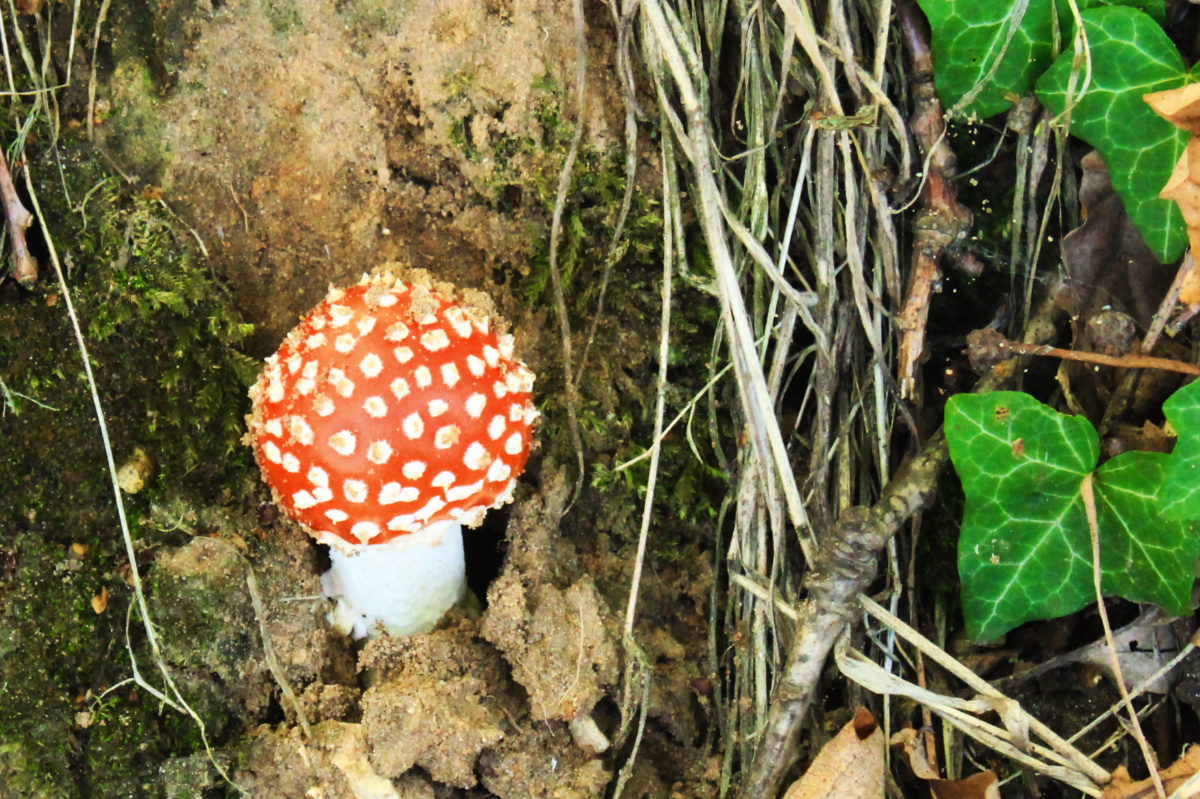
Could it be Rudolf with his nose so bright has been nibbling a certain red-capped mushroom? Fly agaric is extensively found in the Russian woodlands and arguably the source of Mithras’ red hat (both are earth-born). Oh, didn’t I tell you? Most of those hits I’ve had have come from there. From Russia.

So, on this eve of this, Mithras’s special day . . .

Merry Yuletide

May I wish all my readers a happy You ‘ll Tide!

Posted in History, Thoughts | Tagged , , | 7 Comments

The Chap In The (Red) Cap

Another theory from Iris Einstein

Take a Trip . . .

Ladies, Gentlemen, grab your fav snack-pack and liquid refreshment, and climb aboard my immaculate transport (okay, so it’s only a bicycle but I’m not licensed to control any other). Now fasten your seatbelts – no, it’s not for the atrocious state of my ‘cycling; I’m taking you back – way back – to the days of the Roman Empire.

Oh, what’s that you say? That the Empire existed for a long smack of a time, each 50 or so years reeking a different flavour; so just when am I taking you to? I am taking you to an unspecified year twixt 100 and 350 CE. I am taking you to the Danube frontier – though I could as easily take you to the Rhine, or to Hadrian’s Wall – or to the Eternal City itself. The sights I’m to show you would be the same. Yet, there is something of the Danube . . .

Ah! See there’s the river, now in sight.

Birth of the Danube

Donaueschingen in the Black Forest (Germany)
(Photo Source: Wikipedia Commons)

When the Brigach and Breg rivers join they give birth to the Danube. That sounds like something I heard when I was in Germany, at Kassel: “When the Fulda and the Werra kiss, the Wesser is born.”

The Magical Danube

So the Danube doesn’t look anything special yet, but she’ll soon grow.

The Danube at Regensburg

The Danube at Regensburg in Bavaria
(Photo Source: Wikipedia Commons)

Meandering her way between vine-grown hillsides, determinedly flowing twixt cow-pastured meadows, streaming her way through Tolkienesque landscapes, the Danube makes its way to the Black Sea.

Danube at the Iron Gates

The Famous Iron Gates on the Serbian-Romanian border
(
Photo Source: Wikipedia Commons)

Though other continents have longer and wider rivers, those haven’t the magic of the Blue Danube.

Map of the Danube

See, even the cartographers paint her blue!

For the statistics lovers, some statistics.

  • The Danube measures 1,777 miles (2,860 km) from confluence to delta
  • It passes through, or is the border to, ten countries (Germany, Austria, Croatia, Slovakia, Hungary, Serbia,  Romania, Bulgaria, Moldova and Ukraine)
  • It flows through 97 cities, four of which are capital cities (Vienna, Bratislava, capital of Slovakia, Budapest and Belgrade; the most capitals of any river in the world)
  • It forms part of the drainage of a further nine countries (Poland, Italy, Switzerland, Bosnia and Herzegovina, Czech Republic, Slovenia, Montenegro, Republic of Macedonia, and Albania)
  • It has 198 tributaries (from the Iller entering at Ulm, Germany, to the Luncaviţa entering at the small village of Luncaviţa in Romania)
  • And 30 islands
  • It is navigable by ocean ships from the Black Sea to Brăila in Romania
  • It is navigable by river ships to Kelheim in Bavaria, Germany
  • It is navigable by smaller craft as far as Ulm in Württemberg, Germany
  • 60 of its tributaries are also navigable
  • 21 National Parks lie upon its banks.

Its name, Danuvius, is possibly Scythian, possibly Gaulish. Either way, it is derived from a Proto-Indo-European word *dānu (root, *, to flow/be swift, rapid, violent, undisciplined) which forms the name of several other rivers in the eastern range of the proposed P.I.E. heartland (see also the Don, Donets, Dnieper and Dniestr). From the same root comes the Hindu primeval cosmic river goddess Danu, mother of the Danavas.

But the Danube hasn’t always borne that name – or at least, not for all of its length, by all of its habitees. The Ancient Greeks knew it as the Ister, which also means swift flowing; the Dacians and Thracians as Donaris in its upper reaches, but Istros where it flowed past their homes. The Phrygians, whose homes didn’t border upon it at all, called it Matoas, ‘the bringer of luck’.

So, picture painted, huh?

The Roman Garrison

Now we know when and where we are, next is to get more specific, though as yet I’ll give no names, only the generic ‘a Roman garrison’.

In 130 CE, the Imperial Roman army had some 139,000 men deployed along the Danube frontier – excluding officers (centurions and above). These were packaged into 131 auxiliary units that comprised 35 Alae and 95 cohorts, and 11 legions. I could go on to quote how many infantry (auxiliary and legionary), how many cavalry (ditto) but that would be surplus to needs.

For non-Roman specialists I present a map of the Roman Empire in relevant period; inset and slightly enlarged is the Danube frontier. You might care to note how the red ribbon wraps around Armenia, Mesopotamia, Syria, Assyria and Cilicia; unfortunately Crimmie cut me short before I got around to the relevance of that.

Map of Roman Empire 117 CE

So, to return to our trip. Beyond the garrison walls, usually set beside spring or stream, are found a small set of steps leading down; most mysterious this. And look, here is a door. What is this place? A subterranean store? An early refrigerator? Did the soldiers keep their frozen yogurts in here?

Hush. Not so much noise. Has anyone thought to bring a torch? No windows, see, so even at high noon it’ll still be dark in there. Then . . . flummoxed, the door is locked. Ah-ha, but I have the key. It’s big and chunky and made of cold iron. It has an interesting handle: cast in the shape of a raven’s head. (this is I.E.’s personal input; to my knowledge no such keys have been found. Crimson.).

To me, raised in the West, the raven is the bird of death, glutting upon the battle-slain. The Valkyries were said to take raven-form, choosing which of the slain to take to Valhalla. While that might be appropriate for a Roman garrison, the auxiliary units here are mostly Eastern (see the above map) so I wouldn’t expect the raven to relate the same here.

The door creaks – it is heavy. We enter.

cimrm 1901

Found on the left bank of river Pliva (“on a damp site”)
south-west of the mediaeval town of Jajce, Central Bosnia.

The Temple of Mithras

It’s a temple. And while in Rome and its environs actual caves were used, caves don’t grow just anywhere. Thus pseudo-caves were constructed. The one at Jajce had been cut into the bedrock, its floor being some 9 ft below ground level. It was originally roofed though no evidence remains.

A better idea of the layout of these temple-caves can be had from the remains found at Altofen in Hungary (Roman Aquincum). Images from ‘Catalogue of monuments and images of Mithras’ on www.tertullian.org

CIMRM 1750

 Aquincum, Hungary (today’s Altofen)

And this floor plan makes it yet clearer (after a plan given for CIMRM 1750):

Aquincum II Mithraeum

The little blue squares look on the photo like altars;
the accompanying text calls them ‘bases’ (25” tall x 12”x 12”)

As with a Catholic church with its ‘cult of saints’, this temple abounds with statues of both local and imported deities, as well as those common throughout the Empire. But our torch doesn’t light upon them. It shines full upon the centre-piece – which is called a tauroctony.

The Tauroctony

CIMRM 1400

A relief found near Mauls, Austria (Height 47”)

Although the colour on the Mauls relief has been applied since its discovery in 1579, it does follow the colours in two well-preserved frescoes found in Italy, at Marino and Saint Maria, Capua Vetere.

CIMRM 181

S. Maria, Capua Vetere

Mithras Supplement, Marino

Fresco from Marino, Italy

The key colours are the white of the bull and red of the tunic, trousers, and Phrygian cap. The fluttering cape is also red, though often it is lined with the star-studded night sky.

Artistically, these are not the best tauroctonies to survive. Yet they do tell us all we need to know. For this is the Persian god Mithras, as adopted by the Roman army. His cult was the most secretive of the mystery cults that, like mushrooms after the rain, sprang up at the heart of the Roman Empire in the centuries preceding Constantine’s conversion to Christianity. It was that conversion that spelled the death-knell for the Mithraic cult.

There was no written liturgy. The only cult myth is that gleaned from the frescoes, reliefs and statues, and that can be too easily misinterpreted. Though a mass of inscriptions and graffiti survive, these reveal nothing of the cult, only of its members – the one thing we do know is the seven grades of initiation: Corax (Raven), Nymphus (Bride/Bridegroom), Miles (Soldier), Leo (Lion), Perses (Persian), Heliodromus (Sun-runner/Chariot), and Pater (Father). There are a few contemporary accounts but these were written by Christians, post 350, and read like ‘hate-mail’. Hence it isn’t surprising that everyone has a favourite theory about this widespread mystery cult, and a stacks of essays have been written in support. Recent years have also seen a rash of books.

The Mysteries of Mithras

For myself, my interest in the Mithraic cult dates to around 2000 – basically because I like a good mystery and the question-mark hanging over this god’s head is enormous. I read everything I could find on the internet. These were mostly papers in specialist publications, and on ‘Internet Sacred Text Archive’ I found the text that, in 1903, lit the interest of Western scholars: Franz Cumont’s ‘The Mysteries Of Mithra’.

Of all that I read, it was Cumont that struck me as the more thought-out, and thoroughly researched. He gave what he thought was the cult’s origin – Cumont was an Oriental Scholar, academically conversant with Zoroastrianism and the Zend Avesta, which had been made generally available with James Darmesteter’s translation in 1880. And of course, he was well-versed in the Classics, with Persian, Greek and Roman history. He suggested a means of spread for the cult, tracking its entry into the Roman Empire and its subsequent spread, which to my mind cannot be faulted. But he then made the error of reconstructing the liturgy and myth – and for this, more recent scholars has thoroughly slated him. Yet none of their theories have struck me as being in any way close to the answer. They seem to be missing something essential. But neither could I put my finger on it.

Time and again, I came back to the tauroctony. The centre-piece and focus of every mithraeum (the temple-cave), it was to Mithraism what the crucifix is to Christianity. But what does it mean? Why is Mithras always shown with his fingers shoved into the bull’s nostrils, pulling the beast’s head up and back? It’s not that he intends to slit its throat (a more usual way to slaughter a bull) for he jabs his wide blade into the beast’s shoulder. Is that the best way to find the carotid artery? On a broad-shouldered bull? He’s more likely to sever the forlorn beast’s neck artery. (See in the diagram next. Yea, I know it’s a horse but I couldn’t find same for a bull.)

cardiovascular system in quadropeds

From ‘Veterinary On Line’

Mithras, the Red Capped God

And why does Mithras always wear red, like he’s a youthful Santa Claus especially with that hood-like cap? And why does his cape flutter so, as if in the wind? Is this to show that, like the ‘Caped Crusader’, Mithras is able to fly? What, fly, without Santa’s reindeers? And why does Mithras adopt such an odd one-leggedpose?

To show what I mean, take a look at these (though I’d rate them higher, artistically, they lack the colour).

CIMRM 76

CIMRM 76: Parian marble, from Sidon, Syria

CIMRM 76: Wee pointy Phrygian cap, his cape a’flutter, his fingers rammed up the bull’s nose, his right foot upon the sad bull’s rear right leg – is this to identify, in some way, slayer with slain? And note that hound and snake, we’ll come back to them. There’s also a scorpion grasping the bull by its—(oops, let’s be polite)—by its testicle.

CIMRM 736

CIMRM 736: Relief in white marble (H 21”),
found South of Monastero near Aquileia in 1888. Vienna

CIMRM 736: Here the snake is less obvious, slithering under the scorpion which now is centre-stage. But just look at the pointy Phrygian cap, and the flutter of his short shoulder cape. And it’s not just the cape but the skirt of his tunic flutters as well. Also here for the first time we see Cautes and Cautopates, the two attendants of Mithras.  You might also note the attendants’ odd stance; cross-legged, implying they’re also one-legged.

CIMRM 164

CIMRM 164: from Palermo, Sicily

CIMRM 164: Oh, and again we have a one-legged Mithras with Phrygian cap, his cape and tunic both a’flutter; there’s the sky-facing bull – which is usually shown in this collapsed position, maybe to allow the scorpion to clutch at its testicle; and Cautes and Cautopates – by the way, they hold torches, one up-pointing, one pointing down, usually interpreted as either sun-up and sun-down, or the vernal and autumn equinoxes. The snake, here, is centre-stage; and lapping the wound is the faithful hound – it looks to me like a ratter, something like a Jack Russell. Then looking down on the scene (not shown on the previous two examples, they being freestanding tauroctonies) is the Sun and the Moon. And, though it hardly is visible, in the Sun’s face, a raven perches.

cimrm435-circus-maximus

CIMRM 435: Circus Maximus Mithraeum, Rome

CIMRM 435: This is getting repetitive, yet it does emphasise these component parts as being the essentials: Mithras with Phrygian cap, his cape and tunic a’flutter, in a one-legged stance, his fingers shoved up the slain bull’s nostrils. The snake here is eager to lap at the bull’s blood. The hound, ditto. While again, the Sun and the Moon are looking down. The raven, now clearly visible, looks like it’s pecking at Mithras’s cape. And, unusually, this time the attendants stand on both feet.

What you mayn’t have noticed in these scenes is that the bull’s tail is sprouting some kind of grain, probably barley. Plus what I’ve not pointed out in all these scenes is that Mithras looks back over his shoulder. Looking up at the Sun? Or at the raven? The two, Sun and raven, are almost always placed together.

But what does it all mean?

Orion, the Constellation

Like many others, at first I thought the tauroctony was a representation of Orion, and the constellations around him.

Orion & Co

What isn’t show here is Auriga & Perseus above Orion & Taurus
and Eridanus at their feet

Auriga Constellation

Star map of Auriga from Wiki

Everyone knows the myth of Perseus – the Greek demigod who cut off Medusa’s head. The Greeks claimed the Persians were descendants of Perseus, because of similarity of name. In some texts, too, Mithras is given the name of the Medusa-slayer. Perseus.

As for Auriga, this is ‘the Charioteer’. At the end of the Mithraic Myth, as divined from the found relics in he mithraea, Mithras steps into the Sun’s 4-horsed chariot to ascend to Heaven. But Auriga didn’t become a charioteer until the Greeks get into mythologizing the stars. In Mesopotamia, Auriga was said to represent a scimitar (or pruning knife), though also a herd of goats or sheep with their shepherd. In the Zend Avesta, Mithras is also represented as a sheep herder.

Eridanus Constellation

Star map of Eridanus from Wiki

Eridanus was the Celts’ name for the River Po in northern Italy. You can see why the constellation was named for a river; it has the same serpentine path. It is supposedly the waters poured forth by Aquarius, as it is shown in some medieval star maps.

To the Babylonians, the constellation was known as the Star of Eridu – Eridu was an ancient city of the southern marshes of Mesopotamia. The city’s god, Enki-Ea, ruled the ‘cosmic domain of the Abyss’, the mythical source of fresh-water that existed beneath the Earth (there was a mirror to this: the celestial reservoir, whence rain).

There is yet another, quite different, myth attached to Eridanus. It was said to be the crazy-wild path of the Sun-chariot when Phaëton, son of Helios, took the reins (luckily, Zeus intervened and cast a thunderbolt at Phaëton before he could scorch too much of the earth.) Later still, Eridanus was said to be the path of souls – which brings it back to Orion, or Arawn, the Celtic leader of the Wild Hunt who, at his rising on All Hallows Eve, gathers up the souls of the past year’s deceased and takes them to the Summer Land, the Otherworld, Land of the Dead.

Clearly, the tauroctony represents the constellation Orion. Yet I remember the opening line to an essay I wrote when at college, about the caduceus.

A sign is a straight one-for-one replacement, as when the caduceus is used to denote ‘doctors as practitioners of the healing arts’.

A symbol, on the other hand, has multiple connotations the leads the mind into subterranean domains, as when the caduceus is used as an amulet.

It is this richness of ‘multiple connotations’ that makes the tauroctony such a clever symbol of the most secretive of mystery cults. And how the scholars do tie themselves into knots, round and round, like Ouroboros biting their tails – because they do not see what is before them. They have not the eyes.

The Symbols

It was around this time that I picked up a copy of Graham Hancock’s ‘Supernatural’. Yea, I know, his theories tend to hover around what mainstream commentators call ‘the lunatic fringe’ (‘The Sign and the Seal: A Quest for the Lost Ark of the Covenant’; ‘Fingerprints of the Gods: A Quest for the Beginning and the End’; Keeper of Genesis: A Quest for the Hidden Legacy of Mankind’ – with Robert Bauval; The Mars Mystery: A Tale of the End of Two Worlds’ – again with Robert Bauval and also John Grigsby; Heaven’s Mirror: Quest for the Lost Civilisation – with Santha Faiia, his wife). And this latest offering seemed certain to fall into the same, with a subtitle of ‘Meeting with the Ancient Teachers of Mankind’. But the mainstream opinion of him is irrelevant here. Hancock, formerly the East Africa correspondent for The Economist, has well-honed research skills which he uses to support, rather than to shore up, his theories. Moreover, he provides references, he gives quotes, he allows the reader to go back and verify for themselves – which, unfortunately, many other writers in his field do not. But more even than this, he has a reputation that opens doors; he can go places where you and I cannot. Besides, he makes for a good read on a cold winter’s night.

It was the blurb on the backcover that caught my attention:

“50,000 years ago mankind had no art, no religion, no sophisticated symbolism, no innovative thinking. Then, in a dramatic and electrifying change, described by scientists as ‘the greatest riddle in human history’, all the skills and qualities that we value most highly in ourselves appeared already fully formed, as though bestowed on us by hidden powers.”

Human evolution has long been of interest to me, particularly of our super over-kill brain. I won’t say I’ve read every competing theory that tries to explain it, yet I have read most And mostly these centre on the brain’s structure; they postulate either a change in its connectivity, else a change in its chemistry. This would be fine if it had happened before the ‘Out of Africa’ diaspora. But it didn’t.

As Hancock’s blurb says, there is no evidence for its occurrence before 50,000 years ago – and that in the painted caves of southwest France. By then Australia had been settled by modern humans equipped with a brain exactly the same as those Western cave-painters. Now, I’m sure even school-kids know that genes don’t spread without some sexual contact. So explain, if you can, how the early Australians, so long since they shared the same genes, separated, too, by a great distance, displayed the same innovations of art, religion, sophisticated symbolism, invention, as those in the West. Humm?

Doors to the Otherworld

In 1988 David Lewis-Williams and co-researcher Thomas Dowson published their neuropsychological model in ‘Current Anthropology’, according to which theory it was the shamans use of hallucinogenic plants that, in stimulating a pre-existing faculty of the brain, opened the doors to the Otherworld – wide. It was their drug-induced visions that gave rise to the first myths, and formed the inspiration for their cave-art.

Lewis-Williams considers the hallucinations as ‘just silly illusions’, despite that they’ve been the seedbed of our spiritual evolution. Hancock disagrees. He believes the Otherworld visions are an equal reality. His book, Supernatural, bulges with accounts of these Otherworld visions, both those experienced himself and those reported by shamans and in scientific studies. I may not agree with his conclusions, which anyway I found to be muddled, but the bells were ringing right from the start.

Hancock describes his visit to the Pech Merle cave in southwest France. I followed the text with interest, having long been fascinated by the astounding Palaeolithic cave art found at e.g. Lascaux and Altamira.

Lascaux Cave Painting

(Source: Wikipedia Commons)

Now, being Hancock, with his reputation, he was shown caves forbidden to all but the academics studying them. He describes what he calls the ‘Wounded Man’ (alas, no picture to show here), said figure being stuckered by several spears that pass right through him. My first thought was Jesus on the cross with the lance in his side. Then came a flood of memories of books I’d read, of shamanic accounts from Siberia, of initiation rites from Australia, the essence of both was that the shaman or initiate must die to this world, to enter the next. The means are savage, and some are obviously impossible – even if being pierced by white-hot shafts isn’t enough to kill, nor yet being sliced open and all tendon taken, one does not survive decapitation. Hancock provides other examples, all harrowing. I’m reminded of a line from Tim Rice and Lloyd-Webber’s Jesus Christ, Superstar: “To conquer death you only have to die.”

Initiation

I had wondered what form the Mithraic initiations had taken. Pictorial accounts have been found: the ‘Father’ aiming a nocked arrow at the bound candidate, and a garbled account of the new member being thrown into a pit. Two things are certain, and common to all initiations into secret societies. One, it would have included a high degree of humiliation, such as the new member would never admit to an outsider. And two, it would include some terrifying aspect as a test of the initiate’s determination. I guess being shot full of arrows, like St Edmund, would answer that, especially when it’s by the head of your own order.

These painful ordeals seem to be the brain’s way of marking the transition between ‘normality’ and the altered state of conscious. They may be culture dependant, i.e. expectation plays a notable role.

The next bell clanged when Hancock described his experiences in the Peruvian Amazon, drinking of the sacred ayahuasca, the Vine of the Dead. He had visions of therianthrops (the animal-headed humans that populate Ancient Egyptian and Mesopotamian art). There was also a huge serpent that wrapped herself round him, communing to him of acceptance and love. I myself have had that experience in several very vivid dreams, despite being ophidiophobic. But that wasn’t why the bell rang. It was this:

CIMRM 78

CIMRM 78-79 – Lion-headed statuette, Sidon

Aion, the Therianthrop

As a sign, this lion-headed therianthrop equates to the caduceus. The man’s body represents the cosmic pole. The serpent, in writhing around him, turns the world on its axis thus creating the seasons. The lion’s head, not very clear in this photo, represents the heavenly fire that, as well as being the source of lightning, is the source of the conflagration that ends each of the World Ages. His wings, folded at the back, marks him as a divine being, unfettered by the weight of the Earth.

Cumont in his Mysteries of Mithra gives a different, but clearer picture (being a line-drawing) of this lion-headed therianthrop. This one (below) was found in a mithraeum at Ostia, the port of Rome.

Aion

Mithraic Kronos (Æon or Zervan Akarana)
representing Boundless Time

Here, the serpent entwines the body six times – which somewhat destroys the theory of the serpent’s loops representing the seasons, although the four wings at his back are decorated with seasonal symbols. The serpent’s head resting upon that of the therianthrop implies these two (serpent and therianthrop) are in fact just the one being. In his right hand the figure holds a long shafted sceptre to show his authority. He also holds a pair of keys. And what mysteries do they unlock? Engraved on his chest is a thunderbolt – a misnomer, for what is illustrated in the zig-and-zag of a lightning strike. Shown on the base of the statue are hammer and tongs (Cumont assigns them to Vulcan), a cock and a pine-cone (assigned by Cumont to Æsculapius, or Attis), and a caduceus, assigned to Mercury.

Most scholars these days will name this leontocephalous figure as Aion; the name is sometimes found in the accompanying inscriptions. M.J. Vermaseren (in his Mithras, The Secret God) names him as Saturn, and the Titan Kronos, or yet Chronos, the Greek god of Eternal Time – or the Persian god Zervan.

The Persians invented Zervan to serve as father to both Ahura Mazda and Ahriman, for, they said, how could Ahura Mazda (the Good) have created Ahriman (the Evil). It is the same dilemma as found in Isaiah, in the Old Testament when Yahweh says:

“I am the beginning, I am the end, beside me there is no other. I created light, I created dark. I created good, I created evil.”

Yet it is in the nature of light to create shadow. Think of the sun; only at noon is no shadow thrown. And the brighter the light, the darker the shadow. That the Persian Magi were aware of this most annoying conundrum is implied, if not directly said, in the Bundahishn (‘Creation’, or ‘Knowledge from the Zand’), Chapter I.

The therianthrop is a common phenomenon of the shamanic trance, whether the trance is achieved through the use of hallucinogenic plants, or through rhythmic drumming and dance, through hyperventilation, self mutilation (e.g. the Sun Dance), starvation, sensory deprivation, or several other unpleasant techniques of self-abuse. The entwining serpent, whether god or goddess of love, is another commonly experienced phenomenon. Together, they form the Cosmic Deity, hallowed by the many New Age cults, as also by the new forms of Christianity.

The Rain-Bull

The next bell rang when Hancock related the ¡Kung Bushmen tale of the shaman entrancing to fetch the rain-bull from where the demons had corralled it. To me, this was straight from Indo-European folklore, where the clouds are said to be a herd of cattle, and drought is caused by the demons stealing the rain-bull. Yet here it was in South Africa! Moreover, in Hindu myth the god of water, and of the celestial ocean (source of rain) is Varuna, whose name in the Rig Veda is so often twinned as Mitra-Varuna (Mitra, the Hindu form of Mithras) one begins to wonder if they are one and the same. There is a suggestion, from Vedic scholars, that Varuna was the precursor of the Persian Ahura Mazda. Though there’s no mention of his name in the Zend Avesta, it is given as one of attributes of Ahura Mazda. Perhaps I ought to just say that the Hindu Rig Veda and the Persian Zend Avesta are the sacred books of the Indo-Iranians, respectively; by the time of their writing they were two distinct people, yet they shared common origin –on the steppes of Eurasia where flourished the shamans who, with some help of certain plants and dance-and-drumming, climbed a 7-rung ladder to reach the highest Heaven.

Mithraic scholars continually refer to the slain bull of the tauroctony as the ‘Cosmic Bull’ of Zoroastrian myth. Yet there are two strong reasons why this cannot be. One, in Zoroastrianism it’s not a Cosmic Bull that is slain but a Cosmic Cow, or at best a ‘Cosmic Ox’, an ambiguous hermaphrodite. Its ‘maleness’ occurs only after its death when its ‘seeds’, purified by the rays of the moon, give rise the vegetation that replaced that destroyed by Ahriman and his demons. The word ‘seed’ is given also as ‘semen’. Compare this with the blatantly male attributes of the tauroctony bull. Two, the ‘Cosmic Ox’ was destroyed, slowly and painfully, by the fiendish accomplices of the evil Ahriman. To transfer the act of slaying to Mithras is tantamount to saying it was Satan who was nailed to the cross. And yet the image is strong, for the slain bull of the tauroctony, like the Cosmic Ox, has a tail that sprouts corn.

For a long time I saw the tauroctony bull as the water-bull: water-bull, slain, spilling life-giving water in the form of rain, hence the grain. In effect, I equated him with Varuna – though why Mithras should kill his own ‘twin’, his doppelganger so to speak, was beyond me. Yet, in a manner of speaking, I wasn’t far wrong.

The fourth and final bell rang when Hancock said of the ‘Liberty Cap’.

Liberty Caps 

Liberty Caps come in two types. There is the Liberty Cap that was worn as a badge by the freedom fighters of the French Revolution– itself a direct take on the Phrygian Cap which in Classical times was typically worn by newly freed slaves. And there is the Liberty Cap mushroom, Psilocybe semilanceata, also known in certain circles as the “magic mushroom”. To quote Wikipedia: “Of the world’s psilocybin mushrooms, [the Liberty Cap] is the most common in nature, and one of the most potent.” (See pixie – I mean piccie below)

Psilocybe semilanceata (Liberty Cap)

Psilocybe semilanceata
(Source: Wikipedia Commons)

Wikipedia has rather obligingly set a photo of a Phrygian Cap – as worn by another Eastern god, Attis, beside a photo of the Liberty Cap mushroom. But I prefer this one, of Scythian warriors.

Scythian Warriors

Scythian Warriors
( Source: Wikipedia Commons)

The mushrooms, rather like these Scythian warriors, grow in open grassy places, particularly if damp and well-fertilized by the droppings of cattle and sheep – fields, meadows – the steppes. There’s a misconception that it only grows directly on dung, but that applies to its brethren, P. cubensis and P. coprophila; instead, the Liberty Cap feeds on the decaying roots of the grass. As for where, it has a wide a distribution in temperate and subarctic Europe.

Before I go any further, I have to say, I do not advocate the use of these drugs. When taken in the sufficiently high dose to achieve a trance they truly do bring on the frightening physical torments described by Hancock. They are certainly not for recreational use. Drumming and dance can get you there too, though still at a price. There is yet another means, one that slips you into the trance without too much torment from the doorkeeper, though it takes years of persistence and practice to achieve, and that is ‘attended breathing’ meditation. Or maybe that only works for me because, as Hancock says, some 2% of the world population will, at some time in their lives, spontaneously entrance. Maybe I’m one.

So, having cleared myself of the charge of irresponsible encouragement, I now can proceed without constant checking over my shoulder in case Crimmie (CP) is about to pull the plug on me – or rather the plug on the computer.

Psilocybin, its psycho-active ingredient, is closely related, at molecular level, to dimethyltryptamine (DMT) and to the neurotransmitter, serotonin (5-hydroxytryptamine).

Now, a cute thing about DMT is that is ordinarily synthesised and produced in the standard issue human brain. This fact forms the central thrust of Hancock’s theory. Lo, here we are, equipped by our DNA to slip into trance without the (now) illegal partaking of hallucinogens – hence drum-and-dance, starvation and self-mutilation, really do work.

DMT is found in ibogaine, in ayahuasca, in the root bark of  Mimosa tenuiflora . . . the list is long. In western US it’s in reed canary grass and Harding grass. But, strange thing is, our digestive systems produces an enzyme that neutralises it. It has to be combined with a monoamine oxidase inhibitor (MAOI, also used as an antidepressant). Without it, the body quickly metabolizes the drug and, woe, unless the dose is higher than the available MAOI (which then can be lethal) nothing much happens. This, of course, is only relevant when taken orally.

There are ways to concentrate the active ingredient. With psilocybin, to dry the mushrooms, then to steep, to pound, to strain, to do it again – Rig Veda gives the recipe for this, hidden amongst the hymns to Soma.

But, though the Liberty Cap connection is strong, it is entirely the wrong colour for the Mithraic Phrygian cap. His cap is RED – and occasionally shown with white dots. Like this:

Fly Agaric

Amanita muscaria, or Fly Agaric (Source: Wikipedia)

Fly Agaric, the Pixies’ Toadstool

This ‘pixies’ toadstool is said to be poisonous – which it is in a high enough quantity (15 caps). Yet reports of human deaths now are rare. The same cannot be said of some of its close relatives with which it might be confused. But in parts of Europe, Asia, and North America, Fly Agaric is eaten as safely and as often as the Horse Mushroom (Agaricus arvensis), a common crop of grassy grounds. But Fly Agaric does require cooking – which, incidentally, also removes its psychoactive ingredients, muscimol and ibotenic acid.

Ibotenic acid has a strange behaviour. Within 20 minutes to an hour after eating, it is pissed out in a more concentrated form. This enriched urine can then be drunk by another partaker. It has been reported that it can be pissed up to 7 times and still remain psychoactive. Seven, that wonderfully magical number! It is also reported that amongst the Koryaks, an indigenous people of the Russian Far East, the ‘poor’ used to drink the piss of the wealthy, because only the wealthy could afford to buy the mushrooms. In the same region (Eastern Siberia), while the shaman risked his life consuming the mushrooms, others then would drink his urine and achieve trance without the ‘nasties’ and the potential death. Another aspect of Fly Agaric is that in drying the mushroom the ibotenic acid is converted to the more potent muscimol.

Though the Red Capped Toadstool will turn the key to altered states of consciousness, it is not through the magical DMT molecule, and its effects are different. Ibotenic acid and muscimol are akin to the neurotransmitters, glutamic acid and GABA. To quote Wiki again:

“The effects of intoxication can be variously described as depressant, sedative-hypnotic, dissociative and deliriant; paradoxical effects may occur.”

These ‘paradoxical effects’ include macropsia and micropsia – in other words, like Alice, you enter a Wonderland where one moment you’re small and the next you’re a giant, and the pixies are everywhere.

Despite its less than desirable side effects, Amanita muscaria’s red spotted cap marks it as the entheogen of the Mithraic cult, rather than the Liberty Cap.

The Birth of an Entheogen

It was at this point that I discovered Mushrooms, Myth and Mithras, the combined efforts of Carl A.P. Ruck, Mark A. Hoffman and Jose Alfredo González Celdran (2011); incidentally published the same year as Hancock’s Supernatural.

According to the inside back-page blurb, Carl A.P. Ruck, professor of classical studies at Boston University, has previously worked with Swiss chemist Albert Hoffmann and ethnomycologist R. Gordon Wasson to demonstrate the use of ergot (from which LSD is synthesized) as a sacrament in the ancient Greek Eleusinian mysteries (see Persephone’s Quest: Entheogens and the Origins of Religion); Mark A. Hoffman, is editor of Entheos: The Journal of Psychedelic Spirituality; and Jose Alfredo González Celdrán, based in Murcia, Spain, is a professor of ancient Greek; he also has written a book on the role of psychoactive mushrooms in myth and religion. These three authors also collaborated on The Hidden World: Survival of Pagan Shamanic Themes in European Fairytales. 

I wish I had discovered this trio earlier. Ah, but then I wouldn’t have had the satisfaction of arriving at the same place as them. However, it was under the direction of their book that I then found the remaining clues.

When we take a closer look at the imagery of the Mithraic cult we find the evidence for Fly Agaric thickly, though subtly, spread. It’s not restricted to Mithras’s red Phrygian cap, or his fluttering cape which speaks of ‘flying’ (as in a spaced-out trip). And flying, too, is a reference to the Fly Agaric. But that fluting cape also represents the toadstool’s ‘gills’.

Fly Agaric with gills

The cape and tunic of Mithras
(Source: Wikipedia)

It helps if we first understand the life cycle of Amanita muscaria, or Fly Agaric.

A fungus, Fly Agaric appears, ‘born’ of the earth without benefit of parents (yes, we know of the spores but the origin of mushrooms and toadstools was for long a mystery.) Even Pliny thought them “derived from the gum that exudes from the pine-trees.” (Historia naturalis, 32.96) One of the many folk-names is ‘tree-mushroom’; they are also mistaken as the fruit of the tree, i.e. another type of cone. They are the magic apples of folk-tales and myth. These fiery-capped mushrooms magically appear in the aftermath of a thunderstorm – which might explain the torch that the ‘new-born’ Mithras so often holds (lightning being the fire of heaven). Unfortunately the torch is lost from the statue below. (CIMRM 344)

CIMRM 344

CIMRM 344: ‘Rock Born’ Mithras from San Clemente, Rome
But the rock more resembles a pine cone
(I’m reminded of the pine cone on the drawing of Aion which Cumont wanted to assign to Attis. An understandable mistake since Mithras and Attis share many attributes.)

Fly Agaric has a symbiotic relationship with trees, primarily those found growing in rocky terrain – which means pine, spruce, fir, cedar and birch. These are the same species that ‘innocently’ decorate the friezes found on the tauroctony reliefs where the Mithraic Myth is usually shown. In the relief, CIMRM 1o83, Mithras is shown born of a fir/pine tree. And in the detail from CIMRM 247 (below) we find the pine tree sprouting the heads of Mithras and his two attendants.

CIMRM 1083

CIMRM 1083 showing (2nd register from top) Mithras born from a fir tree
Tauroctony with modern recolouring, from Neuenheim, Germany,

CIMRM 247 Detail

CIMRM 247: Tauroctony from Dieberg, Germany, with Mithraic Myth frieze.
Detail showing Mithras, Cautes and Cautopates born of a fir tree

When Fly Agaric first emerges from the ground it has yet to burst out of its sheath. It’s in this stage that it might, lethally, be mistaken for the puff-ball, a fungus that is fully edible.

Fly Agaric 'egg'

(Source: Wikipedia Commons)

In several views of Mithras ‘rock-born’, he is holding a spherical object, interpreted by scholars as the globe, symbolising his rule over the world. I question it.

Rock-born Mithras

Is it a globe – or the globe of Fly Agaric before full eruption
CIMRM Supplement: from Heidelberg, Germany

Mithras, the ‘One-Footed’, is also shown born of an egg.

CIMRM 860

CIMRM 860: Mithras and the egg, from Housesteads, Hadrian’s Wall

In the Zoroastrian hymns, Mithra is said to have one thousand eyes. Hancock, too, mentions eyes as a common feature of an altered states trance. He recounts of a snake, each of its scales becoming an eye, like the iridescent eyes of a peacock’s tail. The ‘eyes’ that speckle Fly Agaric’s cap are the remains of its ‘egg-birth’.

Fly Agaric One-footed, Egg-born

(Source: Wikipedia Commons)

The potency of Fly Agaric’s psychoactive ingredients are greatly increased by drying. They must then be steeped in water, pounded, strained and soaked again. A pot might be useful for this.

CIMRM Supplement, Israel Museum

CIMRM Supplement, from Israel Museum
Note at left base corner, spherical Fly Agaric being prepared for the ‘pot’; beside them, in addition to the tauroctony, is the rock-born Mithras, beneath what looks like a branch of a tree but the text says is a grape-vine; above the bull is a Phrygian capped figure holding an open-capped mushroom – although that’s not what the text says: 

“To the right of Mithras . . . Mithras, wearing a Phrygian cap, stands in front of kneeling Helios, holding the latter’s jaw in his right hand, and places his left hand on Helios’ head. The weathering of the relief has dulled the details [strange it should only affect this particular part], but this seems to be a unique variant on the common ‘investiture’ scene.”

The god Mithras, with his red speckled Phrygian cap, his fluttering cape and tunic, his egg-birth, rock-birth, tree-birth, his one-legged stance that joins him to the white bull (the mushroom’s sturdy white stipe) is without doubt the hallucinogenic fungus, Fly Agaric. What the tauroctony shows us is Mithras as the door and the guide to the Spiritual Otherworld, sacrificing himself so that his followers might partake of his blood (the intoxicant liquid) and thus ascend to heaven with him. But there is more.

The bull’s tail sprouts some kind of grain, barley or wheat. Some of the reliefs are hung about with garlands of grain. And grain, of course, is the basis of bread. We now begin to see why the Christians didn’t much like this mystery cult. For if the sacrificed bull provided both blood and flesh for a sacramental meal . . . the Mithraics were skating close to the Christian Eucharist.

cimrm435-circus-maximus

CIMRM 435: Tauroctony from Circus Maximus mithraeum, Rome
Note the ear of grain sprouting from the bull’s tail; see also how the raven pecks at Mithras’s fluted cape

Raven’s Bread

The Mithraic bread wasn’t grain-made bread, not ‘wheat or barley’ bread. It was Raven’s Bread. Raven’s Bread is yet another folk-name for Fly Agaric found today in parts of Siberia, Afghanistan and Egypt – for the raven is famous for its love of Fly Agaric!

The Raven initiate, the lowest level whose symbols were the cup (chalice or krater) and caduceus, acted as cupbearer at the sacramental feast – a feature of all the mystery cults, not only of Christianity. No need to ask what was in the cup. Bull’s blood.

Bull’s blood has a close association with wine; dried it was used (until banned) to clarify wine. The bull, too, is Dionysus, god of intoxication. But there is more to this than merely blood – be it wine or otherwise. In fact, bull’s blood here can be taken as both urine and semen. For ‘to drink from the bull’s pizzle’ is a euphemism for fellatio. As part of the initiation rites, that ought to have been sufficient to silence forever the new member. Homoeroticism might have been acceptable, one might say even the norm, for the Greeks, but the Romans weren’t having any (they went more for S&M). Moreover, ‘wine-sack’ was a common metaphor for the genitals, and ‘mushroom’ was a metaphor for the penis.

Fly Agaric Phallic

Point made, I would say
(Source: Wikipedia Commons)

Amongst the constellation myths is one for the Raven.

The Raven had dallied at his task of fetching water to eat of some figs. But he lied to Apollo, saying he’d been prevented in his task by the Water Serpent. As punishment the Raven was condemned forever to thirst. So it makes sense for the Raven to be the first level – he must redeem himself first, before he can slake his thirst (and we are not talking here of H2O). Anyway, Apollo flung the Raven (Corvus), the cup (Crater), and the Water-Snake (Hydra) into the sky to be constellations.

Corvus Crater and Hydra

(Source: Wikipedia Commons)

The Raven is variously shown in the tauroctony reliefs:

  • Flying (with a message) from the Sun
  • Pecking at the red Mithraic cape
  • Pecking at the slain bull
  • Perched on the ears of grain that form the tip of the bull’s tail.
  • Pointing at the red Phrygian cap

The bread of the Mithraic sacramental feast wasn’t barley or wheat bread, leavened or not. It was the Fly Agaric entheogen.

The Water Miracle

There is another ‘scene’ in the Mithraic Myth that can now be accounted: ‘the water miracle’. This is usually shown soon after his birth with Mithras either shooting an arrow at, or stabbing with his dagger, what looks like the ‘rock’ of his birth – i.e. the erupting Fly Agaric – from which gushes forth the sacred spring – which we now know is the sacramental drink, aka the bull’s blood, squeezed from the Fly Agaric.

Again, we can see why the Christians so abhorred this cult. Exodus 17, 6: The Lord said: “Strike the rock; water will pour out of it, and the people shall drink.”

However, alas, this is a post on Crimmie’s blog, not a thesis to be published. And so, while there is still so much I can say, I’m aware of the need to draw this short. But there are still three features common to all the tauroctonies: the Scorpion, the Hound and the Serpent.

I don’t agree with Ruck, Hoffmann and Celdrán on this; they launch into astronomy and the precession of the equinoxes. That seems at variance with the other elements in the tauroctony. No, somehow these triad must ne related to the Fly Agaric and the sacramental character of Mithras.

The Scorpion

The scorpion testing the testicle draws our attention to the bull’s ‘wine-sack’, euphemistically speaking (see above). But the scorpion is a dangerous creature, its sting can be lethal. I wonder if that’s the purpose of its inclusion: that while the bull’s blood can transport the imbiber to the Spiritual Otherworld, there is the danger you mayn’t return. And on first sight the snake could be for the same. But no.

The Serpent

The serpent is present at Mithras’s birth (see CIMRM 860 above and CIMRM 1359 Detail below). He also accompanies Mithras when he goes hunting the bull.

CIMRM 1289

CIMRM 1289: Mithras as hunter, from Neuenheim, Germany
Note the ball carried in his hand = the erupting Fly Agaric of his birth;
and, yes, those are fir-trees behind him

CIMRM 1359 Detail

CIMRM 1359 Detail (redrawn):
Line drawing of tauroctony. Königshofen, Strasbourg, France

The lion is said to represent fire, in particular that heavenly variety, shards of which descend to Earth as lightning. And there’s no denying that the serpent represents water, a vital ingredient at the birth of the Fly Agaric-Mithras. But I’d say further that it’s the lethal strike of the ‘fiery snake’ – the lightning and the rain of a thunderstorm. The hunting scene in CIMRM 1289 makes that clear.

And finally, the hound.

The hound has an long and ancient association with death. Finds of dog skeletons in the graves of children in Greece; evidence of a winter solstice ritual of slaying hounds, in the Urals; myths and folklore and legends abounding with hounds that guard the gates of the Underworld. In the Zend Avesta (Fargards XIII and XIV) we find a slightly different take on the dog and death association which I’ll recount because I rather like:

A body upon dying is at once seized upon and inhabited by the Corpse Drug (an evil fiend that feeds upon death). But this can be quite easily expelled by means of the Sag-dîd, ‘the look of the dog’. Ah, but traditionally not any old dog will do. It has to have four-eyes. Since four-eyed dogs do not exist, this probably refers to Yama’s two dogs that watch at the head of the Chinvat bridge to lead the souls of the holy dead. Yama is the Indo-Iranian Lord of the Dead. In practice the Sag-dîd may be performed by a substitute dog, (a shepherd’s dog, a house dog, a four months old dog – even, because birds of prey are ‘fiend-smiters’ too, if no dog is at hand then a hawk or eagle will do).

But I feel there is something specifically Mithraic with the tauroctony hound. But what?

If the tauroctony is taken as a straight representation of the constellation of Orion and the stars around him, then the hound is Sirius, the Dog Star, also called Orion’s Hound. The ancient Greeks took the rising of Sirius as the herald of the hot, dry summer – characterised by unquenchable thirst.

“Wet your lungs with wine: the dog star, Sirios, is coming round, the season is harsh, everything is thirsty under the heat, the cicada sings sweetly from the leaves . . . the artichoke is in flower; now are women most pestilential, but men are feeble, since Sirios parches their heads and knees.”
Alcaeus, Fragment 347 (trans. Campbell, Vol. Greek Lyric I, C7th-6th BCE)

Now, if that ‘unquenchable thirst’ is, rather, a yearning for spiritual union . . . we understand why the dog laps at the bull’s blood.

And now I have Crimmie looking over my shoulder, saying, “Have you seen the wordcount? Don’t you think you’ve written enough?”

Yeah, yeah, yeah, yeah, yeah. But, no, I haven’t. There is still so much more to be said. Okay, okay. I will leave it at this. And as a postscript . . .

Fly Agaric Stamp

I just love this image (from Wiki Commons), with the dancing tunic.
Have you noticed the fox?

Posted in History | Tagged , , , , , | 4 Comments